

You’re scrolling through a group chat or a Snapchat reply, and someone drops a lone “tp” with nothing else attached. No punctuation, no emoji, just two letters sitting there like they’re supposed to explain themselves. Maybe it followed a joke. Maybe it showed up after you sent a photo.
Maybe your cousin used it on Instagram,m and you’re too embarrassed to ask what it means. This kind of moment happens constantly online, because texting slang moves faster than dictionaries ever could, and TP meaning shifts depending on who sent it, where it landed, and what the conversation was doing right before it showed up.
This guide breaks down what TP means in text, how it changes across Snapchat, TikTok, Instagram, and WhatsApp, what tone it usually carries, and how you can reply without sounding lost. By the end, that lone “tp” won’t feel like a puzzle anymore — it’ll just be another piece of normal chat shorthand you understand on sight.
TP Meaning in Text
The short answer: in most modern texting and social media contexts, TP stands for “toilet paper,” and it’s almost always used as a joking reference to the old-school prank of throwing toilet paper over someone’s house, car, or yard, or as a lighthearted way of teasing someone about being broke, messy, or in trouble. Outside of that prank meaning, TP occasionally pops up as shorthand for “trailer park,” “teleport” in gaming chats, or even someone’s initials, but toilet-paper-prank is the version you’ll run into the most in everyday texting.
What makes TP tricky isn’t the definition itself — it’s figuring out which definition applies in the three seconds you have to reply before the conversation moves on. A word this short carries almost no built-in context, so the reader has to borrow context from everywhere else: the platform, the relationship, the time of night, even the punctuation around it.
TP Slang Meaning
At its core, the TP slang meaning functions like inside-joke shorthand more than a formal abbreviation. It rarely shows up as a standalone statement of fact (“I bought TP today” obviously still means toilet paper in the literal sense). The slang version usually appears as a threat, a tease, or a callback to a shared memory — something like “we should tp their house tonight” or “bro got tp’d on Halloween and never recovered.” A pattern worth noticing: when TP shows up as a verb (“getting tp’d,” “we tp’d the yard”), it’s rarely literal. It’s referencing the prank, not the product.
This slang meaning also picks up secondary layers depending on the sender’s age and the platform. Gaming communities lean toward “teleport.” Younger teens on Snapchat and TikTok lean toward the prank reference or use it as a throwaway joke syllable that doesn’t need translating within their friend group. Internet slang evolves this way constantly — a term gets adopted by one small group, gets repeated enough times that it spreads, and eventually shows up in a stranger’s DM with zero explanation attached.
This section only scratches the surface, though — the real confusion usually starts once you see TP show up somewhere unexpected, like a chat app instead of a text thread.
What Does TP Mean in Chat?
In live chat environments — Discord, gaming lobbies, group chats, even LinkedIn message threads in rare cases — TP shifts meaning slightly more toward function and less toward prank humour, though the prank version never fully disappears.
In gaming chats specifically, TP overwhelmingly means “teleport.” Players type it as a quick command or request: “tp to me,” “can someone tp the new guy,” “tp’d into a wall lol.” This is functional shorthand, the same category as “brb” or “afk” — it exists to save typing time during fast-paced play, not to carry emotional tone.
In Discord servers built around gaming, TP as teleport is so dominant that the prank meaning barely registers unless the server is explicitly social rather than game-focused. A pattern worth noticing: the same two letters that mean “toilet-paper someone’s house” in a texting thread between friends almost always mean “teleport me” inside an active gaming voice channel, because the audience and the activity completely change what’s contextually obvious.
Outside gaming, general group chats use TP closer to its texting meaning — jokes about pranking someone, or occasionally as initials when referring to a person by name. Workplace chat tools like Slack or Teams rarely use TP as slang at all; if it shows up there, it’s usually a literal reference to office supplies running low, as in “we’re out of TP in the breakroom.”
Chat Context Depends on the Platform’s Purpose
The biggest signal for decoding TP in any chat isn’t the word itself — it’s what the platform is for. A platform built around real-time coordination (gaming, event planning, logistics) pulls TP toward “teleport” or “meet-up point.” A platform built around social bonding pulls it toward the prank joke. This single distinction solves most of the confusion before you even read the surrounding sentence.
Once you know how chat platforms shape the meaning, it’s worth breaking things down app by app — because Snapchat, TikTok, Instagram, and WhatsApp each have their own texture, and TP doesn’t behave identically on all four.
TP Meaning on Snapchat
On Snapchat, TP almost always circles back to the toilet-paper prank meaning, but it shows up with a distinctly younger, more playful flavour than it does in a regular text message. Snapchat’s user base skews toward teens and young adults, and its disappearing-message format encourages short, throwaway comments that don’t need to hold up outside the moment they were sent.
A common pattern on Snapchat: TP appears as a caption on a Snap showing a house or yard covered in toilet paper, often posted the morning after Halloween or a birthday prank. It also shows up in chat replies to a Snap of someone looking annoyed, tired, or messy — friends will drop “tp’d 💀” as a joking accusation, implying the person looks like they just got pranked even if nothing actually happened.
Snapchat’s Snap Map and location-sharing features occasionally produce a second, more literal use: friends coordinating an actual prank will text “let’s tp [name]’s house tonight” as a real plan, not a joke, which is where the humour and the literal event genuinely overlap.
Streaks, Snap Captions, and Quick Replies
Because Snapchat conversations often exist to keep a streak alive rather than to carry deep meaning, TP sometimes appears with almost no context at all — a single-word reply to keep the exchange going. This is different from Instagram or WhatsApp, where a lone TP reply usually signals an actual reaction to something specific. On Snapchat, it can just be filler that references an old inside joke nobody outside the friend group would recognise.
A pattern worth noticing: TP on Snapchat shows up most often between Friday night and Sunday morning, tracking closely with when actual pranks and parties happen — which reinforces that the slang meaning and the literal prank activity are still tightly linked on this particular platform.
Snapchat sets the tone for younger, prank-heavy usage — but Instagram, TikTok, and WhatsApp each bend the term in slightly different directions once you cross over to them.
TP Meaning on Instagram, TikTok, and WhatsApp
Across these three platforms, TP keeps its core prank-related meaning but gets filtered through each app’s specific culture — comment sections, video captions, and private messaging all shape it a little differently.
On Instagram, TP shows up most often in comments under photos of messy yards, egged houses, or Halloween aftermath posts. It also appears as a tag-style joke — friends commenting “we’re tp’ing this 😂” under a photo of someone’s new car or freshly cleaned room, implying a mock threat to prank it. Instagram DMs use TP closer to how texting does: a quick reference to a shared memory or an ongoing joke between two people who already know the backstory.
A secondary Instagram use worth flagging: bio abbreviations occasionally use TP as initials, especially for smaller accounts or fan pages, which has nothing to do with the slang meaning and trips people up when they assume every TP they see is prank-related.
TikTok
TikTok leans hardest into the prank-video meaning of TP, mostly because “getting TP’d” is a recurring content format — creators filming reaction videos to their house or car covered in toilet paper, often staged for views rather than as a genuine prank. Captions like “POV: you wake up TP’d” or “rating my friends’ TP job” are extremely common, and the comment sections underneath reinforce the meaning through repetition, which is part of why the term has stayed so consistent across the platform.
TikTok’s fast scroll culture also produces a shorter-lived, purely reactive use of TP — commenters dropping it as a one-word joke under any video showing chaos or mess, even when no actual toilet paper is involved, simply because the association has become a meme shorthand for “this looks like the aftermath of a prank.”
WhatsApp skews older and more international than Snapchat or TikTok, and the slang usage of TP is noticeably less common here. When it does show up, it’s more likely to be literal — a genuine grocery list mention of toilet paper in a family or roommate group chat — than a joke. When WhatsApp users do use it as slang, it’s usually because they’ve picked it up from younger relatives or from cross-posting Instagram and TikTok content into the chat, which slowly imports the meaning into a platform that wasn’t originally built around that kind of shorthand.
A pattern worth noticing: the same abbreviation that reads as an obvious joke on TikTok can genuinely confuse someone on WhatsApp, because the platform’s baseline conversation style leans more literal and logistical than playful.
Knowing how each platform bends the meaning helps — but there’s still a bigger question underneath all of this: is TP actually a recognised acronym, or is it just informal shorthand that caught on?
Is TP an Acronym or Short Form?
Technically, TP functions as a short form rather than a true acronym, since it’s simply the first letters of “toilet paper” strung together without forming a pronounceable word of its own. It sits in the same category as initialisms like “BRB” or “OMG” — letters read individually, not blended into a new sound.
Dictionaries and slang reference sites generally list TP under its literal meaning first (toilet paper, and by extension the verb “to TP” something, meaning to prank it with toilet paper), with the internet-slang usage treated as a natural extension of that original definition rather than a separate coinage. This matters because it explains why TP never needed an official “invention” moment the way some slang terms do — it was already an established household abbreviation long before texting existed, and the internet simply repurposed it into a joke format.
Other short forms it sometimes gets confused with include “TBH” (to be honest), “TP” in gaming (teleport, as covered earlier), and regional short forms like “trailer park.” Because all of these share the same two letters, context does almost all the interpretive work — the abbreviation itself gives very few clues on its own.
Understanding that TP is short form rather than a fixed acronym also explains why tone matters so much more than definition when you’re trying to read it correctly — which is exactly where the next section picks up.
Tone & Context Variations
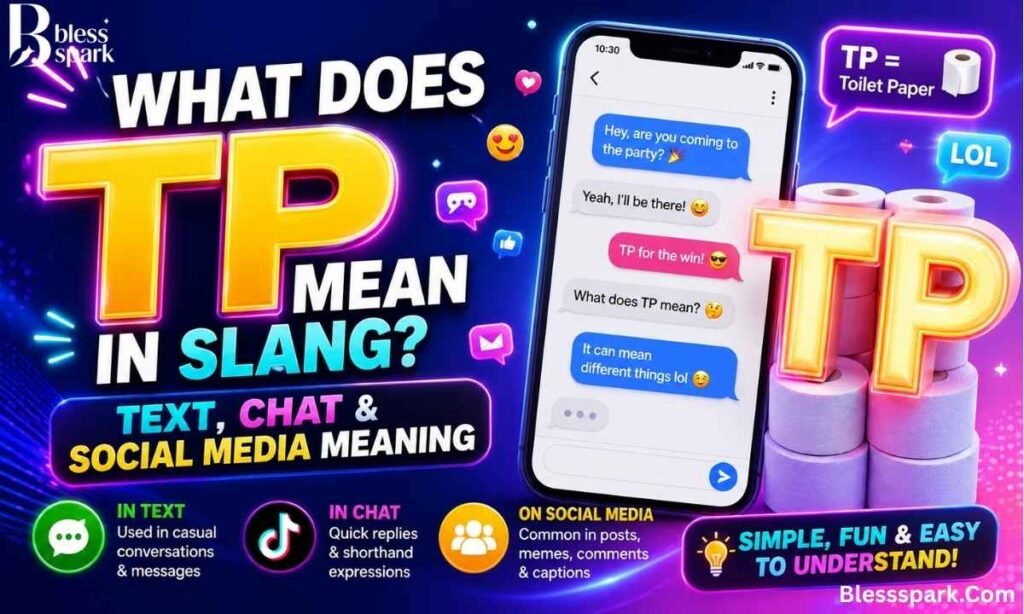
The literal meaning of TP barely shifts, but the feeling behind it changes dramatically depending on tone, punctuation, and who’s sending it. Reading tone in text is genuinely harder than reading tone in person, since you lose facial expression, vocal pitch, and timing — so texters compensate with capitalisation, emoji, and rhythm instead.
Funny Tone
In its funniest form, TP shows up attached to lighthearted teasing — “you got TP’d and didn’t even notice lol” or “we’reTP-ingg his car for his birthday 😭.” The humour usually comes from imagining the chaos of the prank itself rather than the word carrying any wit on its own. Lowercase, casual punctuation, and laughing emoji (😂, 💀, 😭) almost always accompany this version.
Sarcastic Tone
Sarcastic TP usage tends to appear as a mock threat or exaggerated reaction — “say that again, and I’m TP-ing your whole street” — where nobody involved actually expects the prank to happen. The sarcasm comes from pairing a dramatic threat with an obviously minor offence, and it’s almost always read correctly by the recipient because the mismatch in scale signals the joke.
Romantic Tone
TP rarely carries genuine romantic weight, but it can show up in flirty banter between people who share prank-related inside jokes, especially couples who met through mutual friends involved in an actual toilet-papering incident. In these cases, the romance lives in the shared memory, not in the word itself — “remember when you TP’d my house to ask me out” reads as sweet specifically because of the story behind it, not because TP inherently means anything affectionate.
Angry Tone
An angry or annoyed use of TP usually appears after someone actually got pranked and isn’t thrilled about it — “who TP’d my car, this isn’t funny” — often in all caps or paired with a frustrated emoji. A pattern worth noticing: genuine annoyance tends to include extra detail (naming the exact prop, the time it happened, or who’s suspected), while joking annoyance stays vague and short, which is a useful tell for telling the two apart.
Playful Tone
Playful TP usage sits between funny and flirty — friend groups planning a genuine prank as a bonding activity, texting logistics back and forth (“bring extra rolls, we’re tp-ing at midnight”) with clear excitement rather than hostility. This version is common in the days leading up to Halloween, graduation pranks, or birthday traditions among close friend groups.
Recognising these five tone variations makes it much easier to read intent correctly — and seeing them play out in realistic message threads makes the pattern even clearer.
Real Chat Examples (Natural & Relatable)
Reading definitions only gets you halfway there. Seeing TP inside real conversational rhythm shows how naturally it fits into ordinary texting without needing extra explanation.
Example 1
Friend: “dude we got tp’d last night 💀” You: “No way, who did it”
Example 2
Group chat: “Operation TP starts at 11 pm, don’t be late”
Example 3
Sibling: ” Mom said grab TP on your way home; we’re out”
Example 4
Crush, teasing: “Careful, or I’m TP-ing your whole yard next weekend”
Example 5
Gamer 1: “tp to me I found the boss” Gamer 2: “omw”
Example 6
Friend after a mess: “Your room looks tp’d, honestly”
Example 7
Halloween morning: “woke up and the whole porch is tp’d, iconic”
Example 8
Roommate: “Buy more TP this time, not the cheap kind”
Example 9
Best friend: “still can’t believe we tp’d the wrong house lmaooo”
Example 10
Coworker (rare, mostly literal): “office is out of TP again, someone email facilities”
Example 11
Snapchat caption: “tp’d 😭 send help”
Example 12
TikTok comment: “the way they tp’d the whole tree and not just the yard 💀”
Example 13
Instagram DM: “we should tp their car after finals, they deserve it lol”
Example 14
Discord voice chat: “tp me back to spawn real quick”
Example 15
Late-night group chat: “if we’re doing this we’re doing it right, full tp job or nothing”
A pattern worth noticing across these fifteen examples: TP rarely stands completely alone. It’s usually surrounded by a verb form (“tp’d,” “tp-ing,” “tp me”) that gives the reader enough grammatical context to guess the meaning correctly even without full explanation — which leads naturally into how TP actually behaves grammatically inside a sentence.
Grammar & Language Role
TP behaves more flexibly than most slang abbreviations because it can shift part of speech depending on how it’s used — a trait that makes it genuinely useful in fast texting even though it can confuse newcomers.
Part of Speech
Most commonly, TP functions as a noun (the physical product) or a verb (“to TP” something, meaning to prank it). Less frequently, it appears as an adjective in phrases like “TP’d yard” or “TP status,” describing the state something is in after the prank. This flexibility is part of why it spreads so easily — one abbreviation covers three grammatical roles without needing separate slang terms for each.
Sentence Position
TP rarely opens a sentence unless it’s being used as a direct command in gaming (“TP to me now”). In casual texting, it usually sits mid-sentence as a verb or trails at the end as a reaction (“that’s so TP energy,” “got fully TP’d”). Its position inside the sentence often hints at which meaning applies — a leading position leans functional (teleport, command), while a trailing position leans emotional or reactive (prank commentary).
Replacing Full Sentences
Like a lot of internet shorthand, TP sometimes stands in for an entire sentence on its own, especially as a solo reply. A single “tp” sent after a photo of a messy yard communicates an entire reaction — recognition, amusement, a shared reference — without needing any additional words. This kind of compressed communication is common across texting slang generally, but TP does it particularly efficiently because the underlying image (toilet paper draped over property) is so visually specific that almost no explanation is needed once the reader pictures it.
Tone Impact
Capitalisation changes the emotional weight noticeably. Lowercase “tp” reads casual and low-stakes. All-caps “TP’D” reads more dramatic, whether that drama is genuine frustration or exaggerated for comedic effect. Adding extra letters (“tppppp”) or repeating it (“tp tp tp”) almost always signals excitement or disbelief rather than a literal statement.
Formal vs Informal Use
TP essentially never appears in formal writing, professional emails, or academic contexts as slang — it stays confined to texting, chat apps, and social captions. In the rare professional context where it appears, it’s almost always literal (referring to actual paper supplies), which is a useful rule of thumb: the more formal the setting, the more likely TP means exactly what it looks like it means.
Grammar explains how TP moves through a sentence — but knowing how to respond once you’ve received it is the part most people actually search for.
How to Reply When Someone Says TP
Once you’ve correctly read the tone, replying becomes much easier. The right reply usually mirrors the energy of the original message rather than trying to overthink the wording.
Funny Reply
If the message was clearly a joke (“we’re TP-ing your house tonight lol”), match the energy: “bring extra rolls then 😭” or “I’ll leave the porch light off for you.” Playing along signals you got the joke without needing to ask what it meant.
Serious Reply
If TP was used literally, especially in a roommate, family, or coworker context (“grab TP on your way home”), a simple, direct reply works best: “got it, what brand do you usually get” or “already on the list.” No need to add humour where none was intended.
Flirty Reply
If the TP reference is tied to a shared memory with someone you’re interested in, leaning into the nostalgia works well: “still can’t believe you actually did that, best worst night ever” keeps the tone warm without forcing anything.
Neutral Reply
If you’re genuinely unsure which meaning applies, a light clarifying reply keeps things easy: “wait are we talking toilet paper or are you trying to teleport somewhere 😂” This works especially well in gaming-adjacent group chats where both meanings realistically coexist.
Replying well comes down to reading tone accurately first — which is exactly why a side-by-side comparison of TP‘s different meanings is worth laying out clearly.
Comparison Table
| Meaning | Common Platform | Tone | Example Use |
| Toilet paper (literal) | WhatsApp, family texts | Neutral | “grab TP on your way home” |
| Toilet-paper prank (slang) | Snapchat, TikTok, Instagram | Funny, playful, sarcastic | “we’re tp-ing his yard tonight” |
| Teleport | Discord, gaming chats | Functional | “tp to me, found the loot” |
| Trailer park | Regional/informal speech | Neutral to playful | “grew up in the TP” |
| Initials | Bios, captions | Neutral | “@tp.official” |
This table only scratches the surface of how differently TP lands depending on who’s actually using it — which is worth breaking down in more detail.
Who Uses This Term?
TP‘s slang usage skews younger overall, but its reach is broader than a single generation, and where someone lives shapes how often they even encounter the joking version at all.
Age Group
Teens and young adults — roughly the Gen Z and younger millennial range — use the prank-related slang meaning most consistently, largely because toilet-papering as an actual activity remains a recognisable teen tradition tied to Halloween, birthdays, and rivalries between friend groups. Older millennials and Gen X tend to recognise the joke immediately but use it far less often themselves, usually only when referencing a memory from their own teenage years. Gen Alpha, still forming their own slang habits, mostly encounters TP through older siblings’ phones and TikTok content rather than generating the usage themselves yet.
Region
The prank itself is most associated with suburban U.S. neighbourhoods, where enough yard space and a strong Halloween culture make toilet-papering practically feasible. In denser urban areas or countries where the prank tradition doesn’t really exist, TP slang shows up far less organically and is more likely understood only through imported American content on TikTok and Instagram rather than lived experience.
Platforms Where It’s Common
Ranked roughly by frequency of the slang usage: TikTok and Snapchat lead, driven by prank videos and casual captions; Instagram follows closely through comments and DMs; gaming platforms like Discord carry the separate “teleport” meaning heavily; WhatsApp trails behind, staying mostly literal.
A pattern worth noticing: usage tends to cluster around specific calendar windows — Halloween week produces a massive, predictable spike in TP slang across every platform, more than any other time of year.
Knowing who uses the term naturally raises a follow-up question — where did this usage actually come from in the first place?
Origin & Internet Culture Insight
Possible Origins
The literal abbreviation for toilet paper predates internet slang entirely, showing up in grocery lists and product packaging long before texting existed. The prank itself — draping toilet paper over trees, houses, and cars — has been documented as an American teen tradition since at least the mid-20th century, tied loosely to Halloween mischief culture. The internet didn’t invent the prank or the abbreviation; it simply gave both a new stage to perform on, turning a physical prank into shareable content.
Meme & TikTok Influence
Once short-form video platforms took off, “getting TP’d” became a repeatable content format rather than a one-off prank — creators started filming staged reactions specifically for views, which reinforced the term’s meaning through sheer repetition. This is a common pattern in internet slang generally: a term doesn’t need a single dramatic origin moment to spread; it just needs enough repeated exposure across a platform’s algorithm to become instantly recognisable.
Fast Typing Culture
Texting culture broadly rewards short, quickly typed reactions over full sentences, and TP fits that mould naturally because it was already a familiar abbreviation before smartphones existed. Unlike newer coined slang that has to build recognition from scratch, TP had a head start — everyone already knew what the letters stood for literally, which made the leap to a joking, verb-based usage much smoother than it would be for a brand-new term.
Understanding where the term came from also helps answer one of the most commonly searched questions about it: whether TP is actually considered rude or inappropriate.
Safety & Appropriateness
Is TP Rude?
On its own, TP is not considered rude — it’s one of the more harmless pieces of internet slang out there, since the underlying prank is generally viewed as lighthearted mischief rather than genuine harm. Context can shift this slightly: if the “prank” being referenced involves real property damage, harassment, or repeated unwanted targeting of one person, the tone stops being playful and starts crossing into something the recipient might reasonably find upsetting.
Is TP a Bad Word?
No — TP isn’t classified as profanity, an insult, or offensive language in any dictionary or slang reference. It sits comfortably alongside other harmless texting shorthand like “lol” or “omw.” Parents, teachers, and employers generally have no reason for concern if they see it used casually.
Should You Use It in School or Office?
In casual conversation with peers, TP is completely fine in a school setting, since it reflects normal teen social culture. In an office or otherwise formal setting, it’s best kept literal — referencing actual paper supplies rather than the prank meaning — since coworkers and managers may not share the same slang familiarity, and jokes that don’t land can read as confusing rather than funny in a professional context.
Experience-Based Insight
A pattern worth noticing across casual usage: TP almost always appears alongside other slang markers — lowercase typing, emoji, abbreviated words nearby — rather than standing alone in an otherwise formal message. When it shows up in an unusually formal-sounding sentence, that mismatch is usually a signal that the literal meaning applies, not the joke.
With the safety questions cleared up, a handful of quick, direct answers can wrap up anything still left unclear.
Frequently Asked Questions
What does TP mean in text?
It usually means “toilet paper,” most often as a joking reference to toilet-papering someone’s house or yard as a prank.
Is TP rude?
No, it’s generally harmless slang, though context involving real harassment or damage can change that.
What does TP mean on Snapchat?
On Snapchat, TP almost always refers to the toilet-paper prank, often used in captions or playful accusations after something looks messy.
Is TP the same as IDK?
No, they’re unrelated — IDK means “I don’t know,” while TP references toilet paper or, in gaming, teleport.
Can adults use TP slang?
Yes, though adults use it far less often and usually only when referencing a memory from their teenage years.
How do you respond to TP in text?
Match the tone of the message — playful if it’s a joke, direct and literal if it’s a genuine request like buying more toilet paper.
Does TP always mean toilet paper?
No, it can also mean “teleport” in gaming chats or occasionally refer to a trailer park or someone’s initials, depending on context.
Why do people shorten words like TP?
Shortened slang saves typing time and fits the fast, casual rhythm of texting and social media conversations.
Conclusion
By now, that lone “tp” sitting in your notifications shouldn’t feel like a mystery anymore. Most of the time, it’s simply shorthand for toilet paper, usually wrapped around a joke about pranking someone’s house or yard, and the exact flavour of that joke depends heavily on which platform it showed up on and who sent it.
Snapchat and TikTok lean hardest into the prank-and-meme version, Instagram sits somewhere in the middle between comments and DMs, gaming chats and Discord pull it toward “teleport” instead, and WhatsApp keeps things mostly literal. None of these meanings is particularly complicated once you know to look for them, and the grammar around the word — whether it’s acting as a verb, a noun, or a reaction on its own — usually gives you enough clues to read it correctly even without extra explanation.
What matters most is tone: a lowercase, emoji-filled “tp” is almost always playful, while an all-caps or oddly formal one deserves a second look. Slang like this will keep shifting as new platforms rise and old ones fade, but the underlying pattern stays consistent — short abbreviations survive because they’re already familiar, and TP had that advantage from the start. The next time it shows up in your messages, you’ll already know exactly which version you’re looking at, and exactly how to reply.

1 thought on “What Does TP Mean in Slang? Text, Chat & Social Media Meaning”