
You open a group chat, and someone drops a link with just three letters attached: NSFW. No explanation. No context. Just those letters sitting there, and now you’re staring at your screen wondering if you should tap it, ignore it, or ask what’s going on. Maybe a friend texted “lol nsfw don’t open at work” and you’re not totally sure what that changes.
Or you saw it under a TikTok caption and assumed it meant something scary when it’s actually pretty ordinary once you know how people use it. This guide breaks down the real nsfw meaning, where it came from, how it shifts across Snapchat, Instagram, TikTok, and WhatsApp, and what tone it usually carries depending on who sent it.
You’ll also get real chat-style examples, grammar notes, reply ideas, and a full comparison against similar internet slang so you’re never caught guessing again.
NSFW Meaning Slang: What Does It Mean?
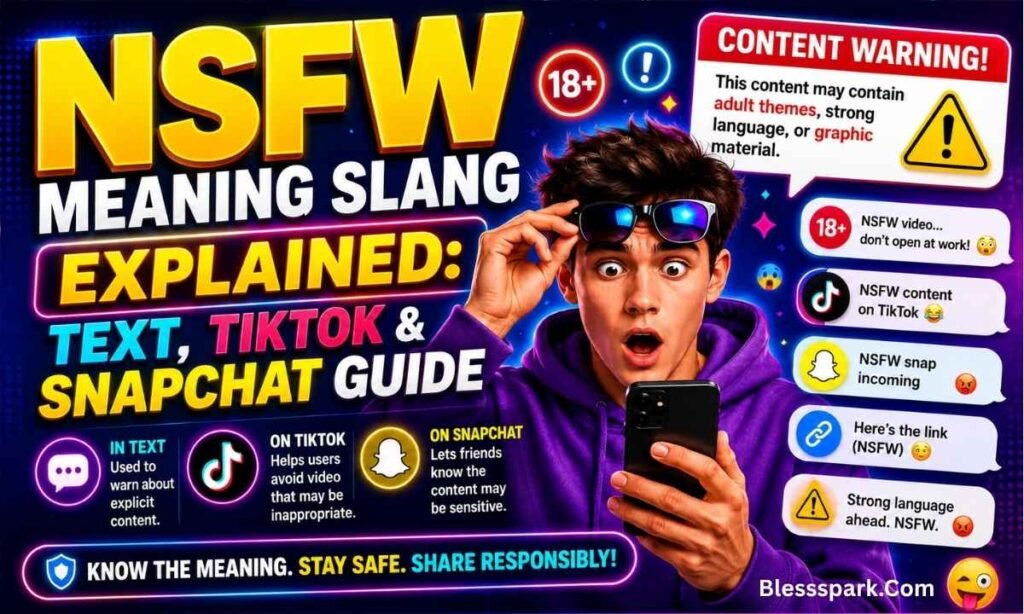
NSFW stands for Not Safe For Work, and it’s used as a warning label attached to content, links, or messages that aren’t appropriate to open around coworkers, family, or in any public setting. That’s the direct answer. Everything else is nuance.
The tag itself doesn’t describe one specific thing — it’s a heads-up, not a category. It gets slapped onto anything from explicit images and sexual content to violent clips, strong language, or even just something loud and chaotic that would look bad if your boss glanced at your screen. The common thread is context, not content type. Something is NSFW because of where you’d be embarrassed to open it, not because of a fixed definition.
A pattern worth noticing: the tag rarely appears on its own; nsfw meaning slang confusion when the sender assumes you already know the shorthand. It’s rarely explained because, in most digital spaces, it’s treated as baseline literacy — like knowing what “lol” means. That’s exactly why new users, older relatives, or people jumping into a new platform tend to get stuck on it.
It’s also worth separating NSFW meaning in text from its most common home: link-sharing culture. The label started as a courtesy tag on forums and image boards, warning people before they clicked something risky on a work computer. It has since spread into everyday texting slang, DMs, and captions, but the original spirit — “heads up, this isn’t office-appropriate” — never really left.
One more distinction matters here. NSFW is a warning, not a judgment. Tagging something NSFW doesn’t automatically mean it’s bad, illegal, or shameful — it just means the timing and setting matter. A person can tag a meme NSFW because it has a swear word in bold text, and that’s a completely different weight than tagging an explicit photo. The letters stay the same; the seriousness behind them depends entirely on what’s attached.
Once you get that the tag is about context rather than a strict content category, the rest of its usage across platforms starts to make a lot more sense.
Is NSFW an Acronym, Short Form, or Slang?
Technically, NSFW is an acronym — each letter stands for a specific word (Not Safe For Work) and the whole thing is pronounced as the string of letters, not as a blended word. But functionally, it behaves like slang because of how loosely and creatively people apply it.
Linguistically, there’s a difference between an acronym, an abbreviation, and slang, and NSFW sits across two of those categories at once. As an acronym, it has a fixed, literal meaning that hasn’t really drifted since its origin. As slang, it’s picked up connotations, tones, and even humour that go well beyond its literal words — nobody typing “this conversation is getting nsfw lol” is thinking about office policy.
This dual identity is part of why it spread so fast. Acronyms with rigid meanings (like ASAP or FYI) tend to stay formal. Acronyms that get adopted into casual internet culture — like NSFW, TMI, or IYKYK — pick up flexible, tone-dependent uses that shift depending on who’s typing and why.
An Observational Pattern Insight worth noting: acronyms that start in professional or moderation contexts (workplace IT policies, forum rules) but get adopted by younger internet users almost always lose some of their original seriousness along the way. NSFW followed that exact curve — starting as a formal content-safety label and softening into something people now use jokingly, flirtily, or sarcastically.
So when someone asks “is nsfw an acronym or slang,” the honest answer is both. It’s an acronym in structure and slang in usage — and that combination is exactly why its meaning shifts so much depending on where you see it.
NSFW Meaning in Text Messages
In a one-on-one text, NSFW usually shows up as either a warning before sending something, or a label after receiving something surprising. The nsfw meaning in text messages context tends to be more personal and less about “the office” and more about “don’t let someone see this over your shoulder.”
A common pattern: it shows up right before a photo, a screenshot, or a link, almost like a verbal knock before entering a room. “nsfw incoming” or “warning nsfw” gives the recipient a second to decide whether to open it right then or wait until they’re somewhere private.
It also appears reactively. Someone sends something unexpectedly bold, and the reply is simply “NSFW 😭” — meaning “I did not expect that, and I definitely can’t have this open right now.” In this use, it’s less a formal label and more an exclamation, almost like saying “whoa, okay.”
Tone in One-on-One Texting
Between two people who already text casually, NSFW rarely carries any weight of judgment. It’s shorthand, not a scolding. Between people who don’t know each other well, though, the same word can feel like a boundary-setting move — a polite way of saying “this is too much” without spelling it out directly.
Group Texts vs Individual Texts
In a group text, NSFW does double duty: it warns everyone at once, and it also low-key excuses the sender from blame if someone opens it at a bad time. “I did say nsfw” becomes the built-in disclaimer. In an individual text, there’s no audience to perform for, so the tag is more functional and less theatrical.
This everyday, texting-specific use is the version most people encounter first — but it looks a little different once you move from private texts into open chat spaces, which is where things get more layered.
What Does NSFW Mean in Chat?
In group chats, Discord servers, and community spaces, NSFW often stops being a one-time warning and becomes a built-in label or channel setting. Many platforms literally let admins mark entire chat rooms as “NSFW channels,” which changes how the term functions completely.
Instead of a person typing the word before sending something, the platform itself enforces it — sometimes requiring an age confirmation, sometimes blurring content automatically, sometimes hiding the channel from search results entirely. This is the more “official” cousin of the casual texting use.
A pattern worth flagging: in large group chats, especially gaming or fandom communities, “nsfw” gets used almost like a genre tag. Someone might post fan art and simply caption it NSFW, and regular members already understand that means “adult-oriented,” without any further explanation needed — the same way someone might label content as “spoiler” or “meme.”
Discord-Style Chat Use
Discord popularised the idea of dedicated NSFW channels, gated behind a toggle that server owners switch on. In this context, the term isn’t really slang anymore — it’s closer to a moderation category, similar to a content rating.
Casual Group Chat Use
In a regular friend group chat (iMessage, WhatsApp, Instagram group DM), NSFW stays closer to its texting roots — informal, quick, dropped in the moment rather than set up as a permanent room feature.
Community and Fandom Chat Use
In fan communities, NSFW frequently separates “safe for general audiences” content from “adult-oriented” content within the same fandom space, letting one group serve two different comfort levels of members.
Chat platforms treat NSFW less like a passing comment and more like infrastructure — which is a big shift from how it behaves once you land on visually driven apps like Snapchat.
NSFW Meaning on Snapchat
NSFW meaning on Snapchat leans heavily personal, because Snapchat itself is built around disappearing, intimate content between people who already know each other. Here, NSFW usually signals that a snap is more revealing, flirty, or private than a typical daily update.
Because Snapchat messages disappear by default, the platform already carries an assumption of privacy — so when someone adds NSFW on top of that, it’s usually emphasising “this one is a step further than usual,” not just “this is casual and gone in ten seconds.”
An Observational Pattern Insight: on Snapchat specifically, NSFW tends to show up far more between people already flirting or dating than in friend-only exchanges, simply because the app’s culture already leans toward closer, more personal sharing than something like a group chat app.
Snap Captions
Some users caption a snap with NSFW as a heads-up before the recipient even opens it, letting them choose the moment rather than being surprised mid-scroll in public.
Snap Streaks and Ongoing Chats
In long-running Snapchat streaks between close friends or partners, NSFW becomes shorthand within an established pattern — it doesn’t need explanation because the relationship context already sets expectations.
Snapchat’s private, one-to-one nature makes NSFW feel more relationship-coded than platform-coded, which is a noticeably different vibe from how it shows up on a public feed like Instagram.
NSFW Meaning on Instagram
On Instagram, NSFW mostly appears in two places: DMs, where it behaves a lot like texting, and captions or story tags, where it acts more like a content warning for a wider audience.
Instagram has stricter content moderation than apps like Snapchat, so NSFW tags on public posts or stories often exist to flag borderline content — not necessarily explicit, but suggestive enough that the poster wants to warn followers (or protect themselves from reports) before anyone scrolls further.
Instagram DMs
In direct messages, the meaning mirrors regular texting — a warning before sending, or a reaction after receiving something bold.
Instagram Stories and Captions
On a public story or post, NSFW functions almost like a disclaimer aimed at a broad, mixed audience — followers ranging from close friends to distant acquaintances or even coworkers who happen to follow the account.
Instagram Close Friends Feature
Interestingly, NSFW shows up less often on the regular main feed and more on Close Friends stories, since that smaller, trusted audience makes people more comfortable posting content they’d tag as NSFW in the first place.
Instagram’s mix of public and private spaces makes NSFW usage more situational than on Snapchat — but TikTok adds a whole new performance element to the term.
NSFW Meaning on TikTok
On TikTok, NSFW often shows up in captions, comments, and even trending sounds, and it’s frequently used more loosely — closer to “spicy” or “bold” than strictly explicit. NSFW meaning on TikTok has stretched to cover content that’s suggestive, chaotic, cringe-inducing, or just intensely awkward, not only sexual material.
Because TikTok’s algorithm pushes content to strangers rather than just followers, creators use NSFW almost like a genre hashtag to pre-warn a massive, unpredictable audience before a clip that’s louder, edgier, or riskier than their usual content.
TikTok Captions
A caption reading “nsfw 😭 don’t watch this at work” is often more about volume, chaos, or secondhand embarrassment than anything explicit — TikTok’s comedic culture has genuinely broadened what counts as NSFW.
TikTok Comments
In the comment section, people frequently drop “nsfw” as a joking reaction to something unexpectedly wild happening in the video, functioning almost like a laughing emoji with extra punch.
TikTok Duets and Stitches
Creators sometimes tag their duet or stitch NSFW purely because the original clip’s audio or visuals are startling — again, stretching the term well past its literal roots.
TikTok’s humour-driven culture has done more to soften and broaden NSFW than almost any other platform — which stands in contrast to WhatsApp, where the tone tends to swing back toward something more private and direct.
NSFW Meaning on WhatsApp
WhatsApp usage of NSFW looks closer to standard texting than to social-media captioning, mainly because WhatsApp chats are mostly one-on-one or small group conversations between people who already know each other well.
NSFW meaning on WhatsApp typically appears before forwarded content, memes, or voice notes that the sender knows might be inappropriate for the recipient’s setting — especially since WhatsApp is heavily used for family groups, coworker groups, and international communication where cultural expectations vary widely.
Family and Community Groups
In multigenerational family groups, NSFW carries extra weight, since the audience often includes people from very different comfort levels — a warning here does real work rather than being a throwaway tag.
Work-Adjacent WhatsApp Groups
Because many workplaces use WhatsApp for informal coordination, NSFW here often means exactly what it originally meant — genuinely inappropriate for a professional setting, not just a joke.
WhatsApp keeps NSFW closer to its literal, cautious roots — but once you start looking at tone rather than platform, the term opens up into a much wider emotional range.
Tone & Context Variations
The letters NSFW never change, but the emotional weight behind them shifts dramatically depending on tone. Reading NSFW flatly, without considering tone, is the single biggest reason people misread a message.
An Observational Pattern Insight: the same three letters read as harmless from a sibling and loaded from a match you talked to yesterday — tone almost always depends more on the relationship between sender and reader than on the words themselves.
Funny Tone
Used for comedic effect, NSFW often has nothing to do with sexual content at all — it’s attached to something absurd, cringeworthy, or wildly off-topic. “the way he answered that interview question… nsfw behaviour” is a joke about awkwardness, not explicit material.
Sarcastic Tone
Sarcastically, NSFW pokes fun at something mundane by exaggerating it. Calling a plate of spicy food “nsfw” is a wink, not a warning — it signals humour through obvious overstatement.
Romantic Tone
In a romantic or flirty exchange, NSFW carries its most literal weight, usually flagging content or conversation that’s genuinely intimate. This is the tone most people assume by default, even though it’s actually just one of several.
Angry Tone
Rarely, NSFW appears in frustrated contexts — someone venting about a chaotic situation and calling it NSFW to emphasise how unfiltered and raw their reaction is, almost like saying “I can’t be professional about this right now.”
Playful Tone
Between close friends, NSFW frequently gets used teasingly, almost as a running joke — reacting to an inside joke or a slightly bold comment with “NSFW 😂” purely for effect, no real content warning intended.
Tone is really the deciding factor in how NSFW should be read — which becomes obvious once you look at how differently it plays out across real conversations.
Real Chat Examples
Seeing NSFW inside actual message exchanges makes the tone shifts much easier to spot than any definition alone.
Example 1
“omg this photo from the party is kind of nsfw lol don’t show your mom”
Example 2
“sending you a meme but fair warning it’s nsfw”
Example 3
“bro that tackle was NSFW 😭 how did he not get hurt”
Example 4
“can’t open this rn i’m at work, and it says nsfw”
Example 5
“the way she roasted him in that video… nsfw energy”
Example 6
“This is getting a little nsfw; should we take it to a different chat”
Example 7
“nsfw incoming, close your laptop if your coworker’s nearby”
Example 8
“That recipe video with all the cheese pulls is honestly nsfw”
Example 9
“My dog just did something nsfw to the couch cushion”
Example 10
“Careful, that thread on Reddit turned nsfw fast”
Example 11
“he sent an nsfw snap, and I wasn’t ready for it”
Example 12
“This TikTok sound is nsfw, headphones only”
Example 13
That argument in the comments got nsfw real quick”
Example 14
“warning: nsfw, this photo shoot went further than expected”
Example 15
“not nsfw exactly but definitely not safe for grandma”
Notice how only a handful of these are actually about explicit content — most lean comedic, dramatic, or exaggerated, which is exactly the pattern that trips people up when they assume NSFW always means one specific thing.
Grammar & Language Role
NSFW behaves a little differently from most texting acronyms, and understanding its grammar helps explain why it fits so naturally into so many different sentence structures.
Part of Speech
Grammatically, NSFW usually functions as an adjective — describing content, a photo, a video, or even a situation (“that photo is nsfw,” “this got nsfw”). Occasionally it acts as a standalone interjection, especially when typed alone as a reaction.
Sentence Position
It shows up most naturally either at the very start of a message (as a warning: “NSFW, don’t open at work”) or attached directly to a noun (as a descriptor: “that’s an nsfw meme”). Both positions are common, and neither reads as more “correct” than the other in casual texting.
Does It Replace a Full Sentence?
Sometimes, yes. Typed completely alone — just “NSFW” with nothing else — it operates as shorthand for an entire sentence: “This is not safe for work, so be careful before opening it.” That compression is exactly why it’s so efficient in fast-moving chats.
Tone Impact
Capitalisation subtly shifts tone. Lowercase “nsfw” tends to read as casual or joking, while all-caps “NSFW” often reads as a more serious, urgent warning — a small but real distinction texting culture has developed over time.
Formal vs Informal Usage
NSFW rarely appears in formal writing, emails, or professional documentation outside of literal content-moderation policy text. It lives almost entirely in informal, digital-first communication — texts, chats, captions, and comments.
Once the grammar clicks, the next natural question is simple: what do you actually say back when someone drops this on you?
How to Reply When Someone Says NSFW
How you respond depends heavily on your relationship with the sender and the tone they used — a mismatched reply can feel awkward fast.
Funny Replies
“Noted, opening this in aeroplane mode” or “Why do I trust you?” work well when the tag was clearly meant as a joke.
Serious Replies
“Thanks for the heads up, I’ll check it later” is a solid, low-pressure response when the content is genuinely private or explicit, and you’d rather not react in the moment.
Flirty Replies
“Now I have to know” or “well now I’m curious” fit naturally in a romantic exchange where NSFW was used intentionally and playfully.
Neutral Replies
“Got it” or a simple thumbs-up emoji works when you just want to acknowledge the warning without adding extra commentary either way.
Knowing how to reply naturally is one thing — but it also helps to see exactly how NSFW compares to the other internet-safety labels floating around chats.
Comparison Table: NSFW vs Similar Internet Slang
| Term | Full Meaning | Typical Use | Tone |
| NSFW | Not Safe For Work | Warns content isn’t office/public appropriate | Varies: casual to serious |
| NSFL | Not Safe For Life | Warns content is disturbing or graphic | Serious, cautionary |
| TMI | Too Much Information | Signals oversharing | Playful, sometimes uncomfortable |
| 18+ | Adult content marker | Age-restricts content directly | Formal, direct |
| SFW | Safe For Work | Confirms content is appropriate anywhere | Reassuring |
| CW | Content Warning | Flags sensitive topics broadly | Careful, considerate |
Key Insight
The biggest difference between these terms is scope. NSFW is about setting (can I view this here, right now), while something like NSFL is about intensity (can I handle viewing this at all), and CW is about topic sensitivity rather than location. Mixing these up is one of the most common misunderstandings in casual chats.
Understanding where NSFW sits among these related tags makes it easier to notice who tends to reach for it most often — and that comes down largely to generation and platform habits.
Who Uses This Term?
NSFW isn’t tied to one single age group, but usage patterns do shift noticeably depending on who’s typing.
Age Groups
Teens and young adults use NSFW the most casually, often stretching it far beyond literal content warnings into humour and exaggeration. Older users tend to use it more literally, closer to its original, cautious meaning.
Gen Z vs Millennials
Gen Z frequently treats NSFW as flexible slang — attaching it to anything chaotic, funny, or intense. Millennials, having grown up alongside the term’s earlier internet-forum roots, tend to reserve it more strictly for genuinely explicit or sensitive material.
Regional Usage
English-speaking online communities worldwide use NSFW fairly consistently, since it originated in early internet forum culture rather than regional slang — though comfort with using it openly can vary depending on local cultural norms around discussing explicit content casually.
Common Platforms
Reddit, Discord, and Twitter/X show the heaviest, most literal use of NSFW as a moderation tag. TikTok, Snapchat, and Instagram lean more toward its casual, tonal, humour-driven use.
Seeing who uses the term, and where, naturally leads into a bigger question — where did this whole labelling habit even start?
Origin & Internet Culture Insight
NSFW traces back to early internet forum and image-board culture, well before smartphones made texting the default form of communication. Workplaces in the early 2000s had far less flexible internet monitoring, and browsing personal content on a work computer carried real risk — so forum users adopted NSFW as a courtesy tag, warning others before they clicked a link that could get them in trouble.
The exact first recorded use isn’t something that can be pinned down with certainty, and it’s more honest to say the phrase emerged gradually across multiple online communities rather than from one single source. What is clear is that it spread through internet culture because it solved a real, shared problem: protecting people from opening something risky in the wrong setting.
An Observational Pattern Insight: terms born out of genuine practical need — rather than pure jokes — tend to have unusually long shelf lives online, and NSFW is a strong example. Decades later, it’s still functionally doing the same job it always did, even as its tone has loosened considerably.
That practical origin story explains why the tag still carries real weight in some spaces even while it’s become a punchline in others — and nowhere is that split more visible than on TikTok.
Why People Say NSFW on TikTok
TikTok’s format — short, fast, algorithm-driven, and often watched in public or shared spaces like classrooms or offices — makes the NSFW warning genuinely useful in a way that’s slightly different from other apps.
Creators use it partly out of real caution (protecting viewers from opening something loud or explicit unexpectedly) and partly as a hook, since tagging something NSFW can spike curiosity and boost watch time. That dual motivation — caution plus attention-grabbing — is fairly unique to TikTok’s culture compared to more private messaging apps.
A pattern worth noting: NSFW tags on TikTok cluster heavily around late-night posting windows, when creators assume their audience is watching privately rather than in a shared space, which slightly loosens what they’re willing to post under that label.
TikTok’s blend of comedy and caution has made NSFW feel almost like entertainment branding — but that shift raises a fair question worth addressing directly: is any of this actually rude to say?
Is NSFW Rude?
On its own, NSFW is not rude — it’s a warning, and warnings are generally considerate, not offensive. The tag exists specifically to protect people from awkward or inappropriate situations, which is the opposite of rudeness.
Is NSFW a Bad Word?
No. NSFW isn’t profanity, and it isn’t inherently vulgar — it’s a label describing content, not a slur or insult aimed at anyone. What it points to can be inappropriate; the acronym itself is neutral.
Should You Use NSFW in School or the Office?
Using the term NSFW in conversation is generally fine anywhere, since you’re just referencing the concept. Actually opening or sharing NSFW-tagged content in those settings is the real issue — that’s exactly the situation the tag was invented to help you avoid in the first place.
Understanding that the word itself is harmless — while the content behind it needs real judgment — is the clearest way to use NSFW responsibly and confidently.
Experience-Based Insight
Across chats, forums, and social captions, a consistent pattern shows up: NSFW works best as a quick, low-effort courtesy rather than a strict rulebook. People rarely stop to define exactly what counts — they trust the recipient to read the room, check their surroundings, and decide when it’s safe to look.
This shows up clearly in workplace-adjacent group chats, where NSFW warnings tend to appear right before lunch breaks or after work hours, timed almost intuitively around when people are more likely to be somewhere private. It also shows up in how quickly people adapt the tag to their own group’s humour — some friend groups use it constantly and jokingly, while others reserve it only for genuinely private content, and both patterns are completely normal.
The term’s staying power really comes down to flexibility. Few pieces of internet shorthand manage to stay useful across forums, texting, TikTok captions, and workplace chat apps all at once — but NSFW has, mostly because its core job (protect the reader from bad timing) never really goes out of style.
Frequently Asked Questions
What does NSFW mean in text?
It stands for “Not Safe For Work” and warns that the content shouldn’t be opened in public or professional settings.
What does NSFW mean on Snapchat?
On Snapchat, it usually flags a snap as more private or intimate than a typical everyday message.
Is NSFW rude?
No, it’s a courtesy warning, not an insult or offensive term on its own.
Is NSFW the same as IDK?
No, IDK means “I don’t know,” while NSFW is a content-safety warning — they’re unrelated acronyms.
Can adults use NSFW?
Yes, NSFW is used by all age groups, though younger users tend to use it more loosely and casually.
How do you respond to NSFW?
A simple acknowledgement like “noted” or “I’ll check it later” works fine in most casual situations.
What is the opposite of NSFW?
SFW, meaning “Safe For Work,” is the direct opposite and confirms content is appropriate anywhere.
Does NSFW always mean adult content?
No, it’s often used loosely for anything chaotic, loud, or embarrassing, not only sexual content.
Why do people put NSFW before a link?
To warn the recipient before they click, so they can choose a private moment to view it.
Is NSFW only used for sexual content?
No, it also covers violence, strong language, or content that’s simply too intense for a public setting.
What does NSFW mean in Discord?
On Discord, it often labels entire channels as adult-oriented, sometimes requiring age confirmation to view.
Can a meme be NSFW?
Yes, memes with strong language, suggestive humour, or graphic images are frequently tagged NSFW.
Is NSFW common on Reddit?
Yes, Reddit uses NSFW as an official content tag across many communities and enforces it through moderation tools.
Should I open NSFW content in public?
It’s best to wait until you’re somewhere private, since that’s exactly the situation the warning is meant to prevent.
Conclusion
At the end of the day, NSFW is one of those small pieces of internet shorthand that carries a lot more nuance than its three letters suggest. It started as a simple courtesy on early forums, warning people before they opened something risky on a work computer, and it’s since grown into a flexible tag used across texting, Snapchat, Instagram, TikTok, WhatsApp, and everywhere in between.
The meaning hasn’t really changed — it’s still about protecting someone from opening the wrong thing at the wrong time — but the tone around it has stretched in every direction, from genuinely serious warnings to lighthearted jokes between friends. Reading NSFW correctly really comes down to context: who sent it, which platform you’re on, and what kind of relationship you have with that person.
Once you notice those patterns, the confusion mostly disappears, and the tag starts to feel like exactly what it was always meant to be — a quick, considerate heads-up rather than something to overanalyse. Whether it shows up as a warning, a joke, or a genre tag on your favourite app, you’ll now know exactly how to read it and how to respond.