

If you’ve come across the letters NTR somewhere online — in a manga tag, a forum thread, a gaming comment, a news headline, or even a username — and had no idea what it meant, you’re not alone.
It’s an unusual case: three letters that mean completely different things depending on where you see them, with almost no overlap between the communities that use them. This guide covers both real meanings in depth, where each one actually shows up, and how to tell which one you’re looking at.
Quick Answer
NTR isn’t general texting slang the way “idk” or “omw” are. It has two established meanings:
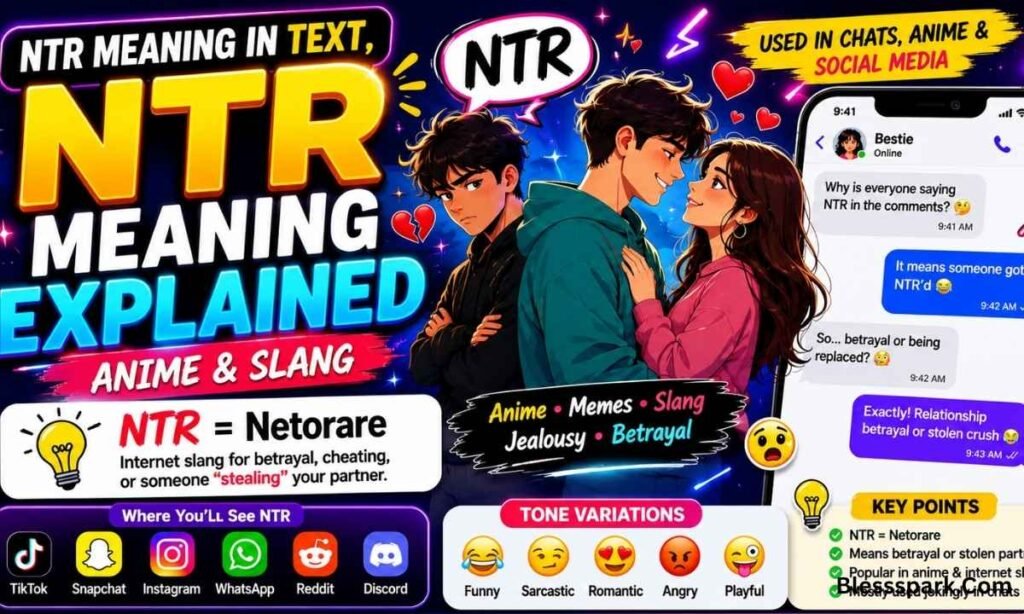
- Netorare — a Japanese storytelling genre, closely tied to adult (hentai) anime, manga, and games, built around a partner being taken away or unfaithful.
- N.T. Rama Rao — the initials of a major Indian film actor and former Chief Minister of Andhra Pradesh.
Which one applies depends entirely on the context. There are also a handful of smaller, industry-specific meanings, covered further down.
NTR as an Anime and Manga Term: Netorare
Netorare (寝取られ), shortened to NTR, is a genre label used across anime, manga, doujin works, and games for stories centred on a romantic partner being seduced, stolen, or unfaithful — told from the emotional viewpoint of the person being betrayed. The word comes from the Japanese verb netoru, meaning to take someone’s partner, with netorare being its passive form: being the one it happens to, rather than the one doing it.
Origin and History
Cuckoldry-focused storylines existed in Japanese adult media before “netorare” became the standard name for the genre. The category as a distinct, named type of story is generally traced to the early 2000s Japanese doujinshi and hentai manga scene, building on cuckoldry tropes that had already been present in adult magazines during the 1990s. Fan discussion and community records point to the abbreviation “NTR” being formalised on hentai-focused game sites in Japan around that same period, as shorthand for “netorare games” specifically.
One title that comes up again and again in discussions of the genre’s history is Triangle Blue, a well-known Japanese visual novel that many Japanese fans treat as effectively synonymous with the genre itself. Its popularity is a big part of why the term spread from a niche doujin label into something recognised across much wider anime and manga fan communities.
It’s worth noting that the term rarely appears as an isolated word online — it shows up attached to a content warning, a genre tag, or a discussion of a specific title. That’s a good clue to what kind of term it actually is: a classification label, not conversational slang.
Netori, Netorare, and Netorase
Fans of the genre often distinguish between a few closely related terms, and mixing them up is one of the most common points of confusion:
- Netorare (NTR) — the story is told from the perspective of the person who is betrayed. The focus is on their jealousy, grief, and powerlessness.
- Netori — the mirror image of netorare, told from the perspective of the person doing the “stealing” rather than the one losing their partner.
- Netorase — a related but distinct category where the partner is shared with the original partner’s knowledge or involvement, which changes the emotional dynamic since the betrayal isn’t hidden.
These distinctions matter to fans because the emotional tone of each is quite different, even though all three revolve around the same basic love-triangle setup. Sites that catalogue this kind of content typically tag works with the specific sub-term rather than lumping everything under NTR.
Why the Genre Has an Audience
It’s a fair question why a genre built around heartbreak and betrayal would have a dedicated fanbase. Fan discussion around it generally points to two draws that don’t always overlap: some readers are drawn to the intensity of the emotional experience itself, since jealousy and powerlessness are strong feelings and fiction offers a safe way to sit with them; others are drawn specifically to the psychological or humiliation elements as a fetish category in their own right, separate from any interest in the “romance” side of the story.
At the same time, it’s one of the more consistently divisive tags in anime and manga fan spaces. Plenty of readers actively avoid anything labelled NTR because the betrayal theme is upsetting rather than appealing. That divide is part of why the tag functions as a warning label as much as a genre name.
Where the Genre Tag Actually Shows Up
Because NTR functions as a content classification rather than slang, it appears in fairly specific, predictable places rather than in general conversation.
Doujin and manga marketplaces. Self-published doujin works are catalogued and sold on marketplaces that rely heavily on tag systems, and NTR is one of the standard tags used so buyers know what emotional territory a work covers before they read it.
Anime and manga databases and forums. Wikis, tracking sites, and community forums use NTR as a searchable genre or trope tag, the same way you’d search for “horror” or “slow burn.” Discussion threads about a specific series will often use it as shorthand once the tag is already established for that title.
Visual novels and dating-sim-style games. Visual novels — an interactive game genre that tells a text-based story through narration and static or sprite-based art — are one of the genre’s biggest homes. Betrayal-focused branching storylines are a well-established trope here, partly because the format (multiple routes, player choice, character relationships) lends itself naturally to a “your partner chooses someone else” storyline.
Reddit and Discord. Subreddits and Discord servers built around specific anime, manga, or visual novel titles use NTR the same way as the wikis and forums: as an established genre tag for content warnings and spoiler discussions, most often in communities dedicated to a specific franchise or to hentai/doujin content generally, rather than in general chat.
NTR vs “Cuckold” in Western Slang
The two overlap but aren’t identical. Netorare is often loosely translated into English as “cuckold,” a term that typically refers to the male partner of an unfaithful woman. The Western slang term tends to be used more broadly and casually across meme culture and adult content in general. NTR, by contrast, is specifically tied to Japanese anime, manga, and game culture, with its own sub-terms and conventions. The genre also puts unusual weight on perspective — netorare stories are usually told from the viewpoint of the betrayed person specifically, most often portrayed as a man, which is a more particular narrative convention than the Western term implies on its own.
NTR as N.T. Rama Rao
Outside anime and manga circles entirely, NTR has a completely different, far more mainstream meaning, especially in Indian cinema and politics.
Early Life and Film Career
Nandamuri Taraka Rama Rao, born May 28, 1923, and widely known by his initials NTR, was an Indian actor, film director, producer, screenwriter, and editor who became one of the most significant figures in Telugu cinema. After debuting in Mana Desam (1949) and taking his first lead role in Palletoori Pilla (1950), his performance in the fantasy film Pathala Bhairavi (1951) made him a star. Over a career spanning more than four decades, he appeared in close to 300 films and became one of the most pivotal figures in the Telugu film industry, especially known for playing mythological and historical figures. He was awarded the Padma Shri in 1968, one of India’s higher civilian honours.
Entry Into Politics
NTR founded the Telugu Desam Party in 1982 and went on to serve as Chief Minister of Andhra Pradesh, becoming the state’s first Chief Minister who didn’t belong to the Indian National Congress party. His rise was fast: he founded the party in 1982 and became Chief Minister within about nine months of entering politics.
His time in office wasn’t without turbulence. In 1984, while he was undergoing heart surgery abroad, the state’s governor removed him from power and installed a different politician in his place, but public and political support led to his reinstatement later that same year. He went on to lead the state a third time after winning the 1994 elections. In total, he served as Chief Minister across four terms, totalling seven years in office, before he died of a heart attack on January 18, 1996, at his home in Hyderabad, at the age of 72.
Legacy and Family
His influence didn’t end with his death. His son-in-law, Nara Chandrababu Naidu, went on to serve multiple terms as Chief Minister of Andhra Pradesh, and his grandson, Nandamuri Taraka Rama Rao Jr. — known professionally as Jr. NTR — became one of India’s leading film stars in his own right. His name lives on through institutions named after him, including the NTR National Award for lifetime achievement in Indian cinema and Dr NTR University of Health Sciences. If you see “NTR” mentioned today in a headline about a new Telugu film, an award ceremony, or Andhra Pradesh political history, it almost always traces back to this legacy — either the man himself or the family carrying his initials forward.
Other Real Meanings of NTR
The anime genre and the actor aren’t the only legitimate things NTR stands for — they’re just the two you’re most likely to run into casually. A few other verified meanings exist in unrelated fields.
In military, government, and aviation contexts, NTR commonly stands for “Nothing to Report,” used in logs and status updates when there’s nothing notable to note for a given shift or period. It’s formal shorthand, not internet slang, and shows up in official reports rather than casual chat.
In the Netherlands, NTR is a public broadcasting organisation whose programming focuses on news analysis, education, culture, children’s programming, and content for ethnic minority audiences. If “NTR” turns up attached to a Dutch TV schedule or a news article about Dutch broadcasting policy, this is almost certainly the meaning.
NTR has also been used as a corporate name for a company originally established to build national toll roads, whose interests have since expanded into other areas — a usage that shows up mainly in business and financial news.
Each of these additional meanings stays confined to its own professional or national context. None of them behaves like slang or spread loosely across unrelated conversations the way genuine internet abbreviations do — which is a useful clue that they’re specialised shorthand rather than something you’d expect to run into outside their specific fields.
Common Misconceptions About NTR
A few misunderstandings about this term come up often enough to be worth addressing directly.
“NTR is a normal texting abbreviation like ‘idk’ or ‘omw.'” This isn’t accurate. Unlike genuinely common texting shorthand, NTR doesn’t have an established, casual usage across general messaging. Its real usage is concentrated in specific fan communities — anime, manga, gaming — and in specific news contexts around Indian cinema and politics, not in ordinary texting between people outside those circles.
“If you see NTR in a comment or caption, it’s automatically a joke.” Not necessarily. Because the term is a genre tag for content that’s often genuinely upsetting to the people it happens to in the story, treating it as automatically lighthearted risks misreading a real content warning as a punchline. Whether the surrounding conversation is actually about anime or manga content matters more than the letters themselves.
“NTR only ever refers to explicit content.” Not quite. The genre tag applies to non-explicit betrayal storylines too, and as covered above, the same three letters carry entirely unrelated meanings in Indian cinema, Dutch broadcasting, and formal reporting. Assuming one fixed meaning for NTR in every context is the fastest way to misread what’s actually being discussed.
Is NTR Rude or Inappropriate to Use?
This depends on which meaning and which setting you’re in. As a genre tag in anime, manga, and gaming spaces, NTR isn’t a slur or insult on its own — it functions as a content descriptor, similar to labelling something “horror” or “slow burn.” But because the genre is so strongly tied to adult content, casually dropping the term in a school, workplace, or family setting can come across as odd, simply because of what it’s usually attached to. It’s not something you’d want typed into a professional chat, since it can easily be misread or looked up by someone unfamiliar with the context.
As the initials of N.T. Rama Rao, there’s nothing inappropriate about the term at all. It’s used respectfully and constantly in Indian news coverage, film journalism, and everyday conversation across Telugu-speaking communities.
Confusion between the meanings tends to happen almost exclusively to people outside both communities — anime fans rarely confuse it with the actor, and followers of Telugu cinema rarely confuse it with the genre tag. The overlap is really a search-engine problem more than a real-world one.
How to Tell Which Meaning Is Being Used
A quick way to sort out which NTR you’re looking at:
- Anime character names, manga tags, hentai warnings, visual novel or gaming forums → almost always Netorare
- Indian cinema, Telugu film industry, Andhra Pradesh political history, biopic titles → almost always N.T. Rama Rao
- Military logs, aviation reports, government paperwork → almost always Nothing to Report
- A Dutch TV listing or broadcasting news story → almost always the Dutch public broadcaster
- A random text message with no context at all → probably none of the above — most likely a typo or something specific to that conversation, worth just asking about directly
Comparison Table
| Meaning | Field | Core Idea | Where You’ll See It |
| Netorare (NTR) | Anime, manga, games | Betrayal/infidelity genre tag | Doujin sites, manga wikis, visual novel forums, hentai databases |
| N.T. Rama Rao (NTR) | Indian cinema & politics | Actor and former Chief Minister | News headlines, Telugu film coverage, Andhra Pradesh political history |
| Netori | Anime, manga, games | Same genre, from the “other” partner’s perspective | Same platforms as netorare |
| Nothing to Report (NTR) | Military, government, aviation | Formal status shorthand | Logs, reports, official communication |
| NTR (broadcaster) | Dutch media | Public broadcasting organization | Dutch TV listings, broadcasting news |
Frequently Asked Questions
Is NTR a common texting abbreviation?
Not really — there’s no solid evidence it functions as everyday chat slang. Its real meanings come from anime/manga genre culture, Indian cinema and politics, and a few specialised fields like military reporting and Dutch broadcasting.
What does NTR stand for in anime?
Netorare — a genre tag for stories centred on a partner being taken away or unfaithful, usually told from the betrayed partner’s perspective.
Is NTR always explicit or adult content?
Not always, but it’s strongly associated with hentai and adult-rated works. Non-explicit stories with the same betrayal theme exist but are tagged this way less often.
Who is NTR in Indian entertainment?
Nandamuri Taraka Rama Rao, a major Telugu film actor and three-time Chief Minister of Andhra Pradesh. His grandson, Jr. NTR, is a leading actor today.
If someone texts me “ntr” with no context, what does it mean?
Without anime, manga, or Indian-cinema context around it, it’s most likely a typo or something specific to that conversation — simplest to just ask.
Conclusion
NTR isn’t really a mystery once you know where it comes from — it’s a term that happens to carry several unrelated meanings depending on which corner of the internet, or which industry, you’re standing in. In anime, manga, and gaming spaces, it traces back to Netorare, a genre with real history in Japanese doujin culture, its own internal sub-categories, and a reputation as one of the more polarising content tags fans encounter.
In Indian entertainment and political history, it’s the initials of a man whose career as an actor and Chief Minister still shapes Telugu cinema and Andhra Pradesh politics through the institutions and family carrying his name forward. And in a few specific professional corners — military logs, Dutch broadcasting, corporate naming — it means something else again, with no crossover at all.
The meanings rarely collide in real conversation; the confusion mostly comes from search engines flattening several unrelated things into one set of letters. Once you know the context clues, telling them apart takes about two seconds.

2 thoughts on “What Does NTR Mean? A Complete Guide”