

You open a message, and there it is: AITA. No context, no explanation, just four letters sitting in the middle of a sentence like they’re supposed to mean something obvious. Maybe a friend sent it after a fight with their roommate. Maybe it showed up as a caption under a TikTok.
Maybe someone dropped it in a group chat, and everyone else just kept talking like nothing strange happened. If you’ve never seen it before, it can feel like you missed a memo the rest of the internet already read. That’s normal, and it’s exactly why this guide exists. AITA-meaning questions spike every time the term jumps from one platform to another, because the letters stay the same while the tone around them keeps shifting.
Below, you’ll get the plain definition, the slang version, how it behaves differently on Snapchat versus Instagram versus WhatsApp, real chat examples, the grammar behind it, and simple ways to respond so you’re never caught guessing again.
AITA Meaning Explained
AITA stands for “Am I The Ahole,”** a phrase people use when they want an outside opinion on whether they acted badly in a situation. It started as shorthand for describing a personal conflict and asking someone else to judge it fairly.
The core idea never really changes: someone did something, isn’t sure if it was fair or selfish, and wants a second opinion. What changes is the delivery. In a text, it can read as a genuine question. In a caption, it often reads as a setup for a story. In a group chat, it usually means “let me explain what just happened, and you tell me if I’m wrong.”
AITA Meaning in Text
In a one-on-one text, AITA meaning in text almost always points to a real, specific event the sender just went through. It’s rarely random. Someone typically follows it with two or three sentences describing what happened, then waits for a reaction.
An Observational Pattern Insight worth noting: this version tends to arrive right after the disagreement, not hours later — the message often reads like it was typed mid-emotion, with the explanation slightly out of order because the person is still processing it.
AITA Slang Meaning
As slang, AITA has stretched beyond asking for judgment. Some people now use it loosely to mean “was that a weird thing to do,” even for situations with zero real conflict, like eating the last slice of pizza or texting someone back too fast. The AITA slang meaning has softened over time from “settle this argument” to “give me a quick reaction.”
What Does AITA Mean in Chat?
Inside ongoing chat threads, especially ones with a back-and-forth history, AITA often functions as a shortcut. Instead of writing “I need your honest opinion on something I did,” the sender just drops the letters, because the relationship already has the shorthand built in.
AITA Meaning on Snapchat
Snapchat’s format changes the tone slightly. Because messages disappear and snaps are quick, AITA on Snapchat tends to show up attached to a photo or a short video rather than a wall of text — a screenshot of a text exchange with “aita” typed underneath, for instance.
A pattern worth noticing: on Snapchat, the term shows up more in private stories than in one-on-one chats, since people are often fishing for a group reaction rather than a single opinion.
AITA Meaning on Instagram, TikTok, and WhatsApp
Each app leans into a different version of the same word. On Instagram, it usually appears in comments or story replies reacting to someone else’s post. On TikTok, it’s practically a genre of its own, often as a caption on a story-time video. On WhatsApp, it stays closer to its original texting use, since WhatsApp is still mostly used for direct, personal conversations rather than public content.
Is AITA an Acronym, Short Form, or Slang?
Technically, AITA is an acronym, since each letter stands for a full word. But in daily use, it behaves like slang, because people use it loosely, without always meaning the literal phrase word-for-word. It’s fair to call it acronym-based internet slang rather than a strict abbreviation like “ASAP.”
The meaning holds steady across platforms, but the weight behind it doesn’t — and that difference in tone is where most confusion actually comes from.
Tone and Context Variations
The letters “AITA” never change, but the emotional temperature around them shifts a lot depending on who’s sending it and why. Reading the tone correctly matters more than knowing the definition.
Funny Tone
In a funny context, AITA gets attached to low-stakes situations on purpose, almost as a joke about how dramatic the phrase sounds. “AITA for finishing the show without you” is a classic example — nobody actually thinks it’s a moral dilemma, and that’s the joke.
Sarcastic Tone
Sarcastic AITA usually follows a story where the answer is obviously “no, you weren’t wrong,” and the sender already knows it. They’re not asking for judgment; they’re venting about someone else’s bad behaviour and using AITA as a rhetorical flourish.
An Observational Pattern Insight here: sarcastic AITA messages tend to be longer than genuine ones, because the sender is building a case rather than asking an open question.
Romantic Tone
Between partners or people who are flirting, AITA sometimes shows up in a softer, teasing way — “AITA for wanting you to text me back faster” — turning a small annoyance into something playful instead of confrontational.
Angry Tone
When someone is genuinely upset, AITA can carry real weight. The message is longer, more detailed, and less joking. In these cases, the person usually wants validation, not just an opinion, so a dismissive answer can land badly.
Playful Tone
Playful AITA sits between funny and romantic — used among close friends over harmless disagreements, like who forgot to save the last fries. It signals closeness more than conflict, since only people comfortable with each other bother joking about being “the a**hole” over something small.
Tone is really the deciding factor in how you should respond, which is exactly what the next few sections will help you read correctly.
Real Chat Examples of AITA
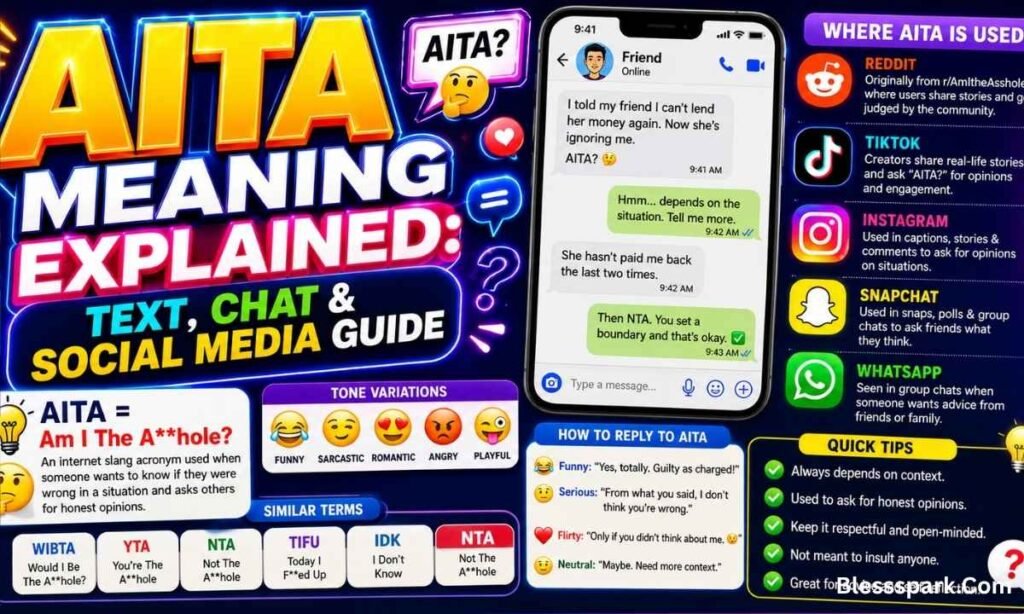
Seeing AITA used in context makes the pattern click faster than any definition can. Below are realistic examples across different relationships and platforms.
Example 1
“AITA for not inviting my cousin to my birthday dinner? It was small on purpose.”
Example 2
“AITA for leaving the group project chat lol they weren’t doing anything anyway”
Example 3
“AITA for telling my roommate her music was too loud at 1 am?”
Example 4
“lowkey aita for not texting back for 3 days, i just needed space”
Example 5
“AITA for wanting to split the bill evenly even though I only had a salad”
Example 6
“AITA for skipping my friend’s wedding shower because of work”
Example 7
“AITA for telling my sister her boyfriend seems shady”
Example 8
“Not me asking AITA over a group chat meme; I need validation rn”
Example 9
“AITA for wanting alone time after a long week even though my partner planned a whole date”
Example 10
“AITA for correcting my coworker in front of the team; they were wrong”
Example 11
“AITA for not lending my charger to someone I barely know”
Example 12
“AITA for muting my best friend’s story updates; she posts like 40 a day”
Example 13
“AITA for telling my mom I can’t come home this holiday”
Example 14
“AITA for being annoyed my date was on their phone the whole time”
Example 15
“AITA for cancelling plans last minute because I was exhausted”
A pattern shows up across nearly all of these: the person already senses the answer, and the message is less about needing a verdict and more about needing someone to listen first. That instinct also shapes how AITA behaves grammatically, which is worth breaking down next.
Grammar and Language Role of AITA
Even though AITA feels casual, it follows fairly consistent grammatical habits once you notice the pattern.
Part of Speech
AITA functions as a question, standing in for a full interrogative sentence. It behaves almost like a compressed clause rather than a single word, similar to how “IDK” replaces “I don’t know.”
Sentence Position
Most commonly, AITA opens the message, immediately followed by “for” and the explanation — “AITA for doing X.” Less often, it closes a message after the story has already been told, working more like a tag question.
Does It Replace a Full Sentence?
Yes. AITA effectively replaces “Am I in the wrong here?” or “Was I being unreasonable?” It’s a full question compressed into one term, which is part of why it spread so fast — it’s efficient.
Tone Impact
Capitalisation changes how it reads. All-caps “AITA” often signals higher emotional intensity or humour, while lowercase “aita” tends to read as more casual or offhand, blending into a sentence rather than standing out.
Formal vs Informal Use
AITA is strictly informal. It has no place in professional writing, official messages, or anything meant to be read outside a personal or social context. Its entire function depends on a casual, conversational tone.
Understanding the grammar helps explain why some replies land better than others, which brings us to how to actually respond.
How to Reply When Someone Says AITA
The best reply depends almost entirely on tone, but a few reliable templates work across most situations.
Funny Reply
“100% the a**hole but I’d have done the same thing” works well when the situation is clearly low-stakes, and the sender is looking for a laugh, not a lecture.
Serious Reply
When the message reads as genuinely upset, a grounded response like “No, that seems fair honestly — here’s why” respects the weight behind the question instead of brushing past it.
Flirty Reply
In a romantic or teasing context, something like “Absolutely the a**hole, but you’re my favourite one” keeps the playful tone going without dismissing what they said.
Neutral Reply
If the tone is unclear, a safe middle-ground answer — “Depends, what actually happened?” — buys time to read the situation better before committing to a side.
Matching tone matters more than being clever, since a joke reply to a genuine vent can come across as dismissive fast.
Comparison Table
| Term | Common Meaning | Typical Tone | Best Response Style |
| AITA | Am I The A**hole | Ranges from joking to genuinely upset | Match the sender’s tone before replying |
| IDK | I don’t know | Neutral, low-effort | Simple acknowledgment |
| TBH | To be honest | Direct, sometimes blunt | Honest, brief reply |
| NGL | Not gonna lie | Casual confession | Light, conversational |
| YTA | You’re the a**hole (a response, not a question) | Judgmental, often used to answer an AITA post | Direct agreement or pushback |
This table is a quick way to see how AITA sits among its closest relatives — related in style, but distinct in what it’s actually asking for.
Who Uses AITA?
AITA isn’t tied to a single age group or app anymore, but usage patterns still vary depending on who’s typing it.
Age Groups
Younger users tend to use AITA more loosely in small, everyday situations, while older users are more likely to reserve it for actual disagreements worth debating.
Gen Z vs Millennials
Gen Z tends to use AITA in captions, memes, and lighthearted posts, treating it almost like a genre label. Millennials lean toward using it closer to its original purpose — asking for a real opinion on a real conflict, often in a private message rather than a public post.
Regions
The term spread globally through English-language internet culture, so usage is heaviest wherever English-language social platforms dominate daily communication, though non-native speakers increasingly use it too, picked up directly from trending posts rather than textbooks.
Platforms
Usage is heaviest on platforms built around text and short video — TikTok, Instagram, and group messaging apps — and lighter on platforms built for professional or public broadcasting, where casual slang doesn’t fit the format.
A pattern worth noting: the more public the platform, the more exaggerated the situation described tends to be, since public posts perform better when the story has a clear right-or-wrong angle.
Origin and Internet Culture Insight
AITA didn’t appear overnight — it grew out of a specific corner of online culture before spreading everywhere else.
Possible Origin
The term is widely tied to a Reddit community built entirely around people describing conflicts and asking strangers to judge who was wrong. If the exact first use outside that space isn’t fully documented anywhere reliable, it’s fair to say plainly: the precise origin point is unclear, even if the community that popularised it is well known.
TikTok Influence
TikTok accelerated AITA far beyond its original space by turning it into a storytelling format — creators narrate a conflict on camera, ask “AITA,” and let the comment section argue it out, which turned a written phrase into a spoken one too.
Meme Culture Role
Because the phrase is inherently a little dramatic-sounding, it lends itself easily to jokes. Meme culture picked it up for exaggerated, obviously trivial scenarios specifically because the mismatch between the serious-sounding question and the silly situation is funny on its own.
Fast Typing Culture
Shorthand like AITA also fits naturally into a texting culture built around speed. Typing four letters instead of a full sentence saves time without losing meaning, which is the same logic behind most enduring text slang.
Why People Say AITA on TikTok
On TikTok specifically, AITA functions as a hook. Creators use it early in a video because it signals “there’s a debate coming,” which keeps viewers watching to see which side they land on.
The jump from a niche Reddit phrase to a mainstream TikTok hook says a lot about how fast internet language travels once it proves genuinely useful.
Is AITA Rude or Appropriate?
Whether AITA is appropriate depends heavily on where it’s used and who’s reading it.
Is AITA Rude?
On its own, AITA isn’t rude. It’s a genuine question format, even when it includes a slightly harsh-sounding word. Context, not the term itself, is what determines whether it reads as offensive.
Is It a Bad Word?
The full phrase does include a mild swear word, so tone-sensitive spaces — like messages to someone older, or more formal relationships — are better served by softer alternatives such as “was I wrong here.”
Should You Use It at School?
In casual conversations between students, AITA is common and generally harmless. Around teachers, in assignments, or in any school-monitored communication, it’s best avoided given the language inside it.
Should You Use It at Work?
Work messages, even casual ones between coworkers, are safer without AITA. It’s fine in a private, personal chat with a colleague you’re close with outside work, but risky in anything that could be seen by a manager or HR.
The safest rule across all of these: read the room before the word.
Experience-Based Insight
Patterns around AITA tend to repeat in fairly predictable ways once you start noticing them across enough conversations. It shows up disproportionately at night, when people are replaying an argument or an awkward interaction from earlier in the day and want a reaction before they can let it go.
It shows up disproportionately in group chats compared to one-on-one messages, since a group gives the sender more voices to weigh in with. And it shows up far more often attached to genuinely small situations than to major ones — most real, serious conflicts get described in full sentences, not compressed into four letters, because people instinctively slow down when something actually matters.
Another consistent detail: the punctuation, or lack of it, tends to say almost as much as the words. A period after AITA often signals a flat, matter-of-fact tone. No punctuation at all, especially in lowercase, usually reads as more relaxed or joking. A question mark stacked with extra letters — “aitaaa??” — tends to signal genuine anxiety about the answer, not humour. None of this is written anywhere as an official rule, but it’s a pattern that holds up across enough casual conversations to be worth knowing before you reply.
Conclusion
AITA looks like a simple four-letter shortcut, but the meaning behind it depends entirely on who sent it, where it landed, and what mood they were in when they typed it.
At its core, it’s a request for judgment — a compressed way of asking “was I wrong here” — but the tone wrapped around that question can range from genuinely upset to completely joking within seconds of each other. Reading the platform, the relationship, and the punctuation around it tells you more than the letters ever could on their own.
Once you notice that pattern, the term stops feeling confusing and starts feeling almost predictable, whether it shows up in a Snapchat caption, a WhatsApp vent, or a TikTok story-time hook. The next time it lands in your messages, you won’t need to guess what’s actually being asked, and you’ll have a much better sense of how to answer without misreading the room.
Frequently Asked Questions
What does AITA mean in text?
It means “Am I The A**hole,” used to ask whether someone acted unfairly in a situation.
What does AITA mean on Snapchat?
The same core meaning, usually attached to a photo, video, or private story asking for a reaction.
Is AITA rude?
Not inherently — it depends on context, tone, and where it’s being used.
Is AITA the same as IDK?
No, IDK means “I don’t know,” while AITA is a specific request for judgment on a situation.
Can adults use AITA?
Yes, it’s used across age groups, though usage style and frequency shift by generation.
How do you respond to AITA?
Match the tone — playful for jokes, honest and direct for genuine concerns.
What does AITA mean on TikTok?
It’s often used as a story-time hook to introduce a conflict and invite comment-section debate.
Where did AITA originate?
It’s widely tied to a Reddit community built around judging personal conflicts, though the exact first use elsewhere is unclear.
Does AITA always mean Am I The Ahole?**
Almost always, though some casual users stretch it to mean simply “was that weird.”
Is AITA a texting abbreviation?
Yes, it’s a texting and internet slang abbreviation, not a formal acronym.
Why is AITA so popular online?
It compresses a full question into four letters and taps into people’s interest in judging conflicts fairly.
Can AITA be used as a joke?
Yes, it’s frequently used sarcastically or humorously for low-stakes situations.
Is AITA only used on Reddit?
No, it has spread widely to texting, Snapchat, Instagram, TikTok, and WhatsApp.
What is the opposite of AITA?
There isn’t a true opposite, though “NTA” (Not The A**hole) functions as the answer confirming someone wasn’t wrong.

1 thought on “AITA Meaning Explained: Text, Chat & Social Media Guide”