

You open a chat, see three letters — TLC — and your brain stalls for a second. Is it a compliment? A brush-off? Something a friend types without thinking twice, or something a crush drops on purpose? That tiny pause before you type back “wait what does that mean” is more common than people admit.
TLC has floated through texts, comments, and captions for years, and its meaning shifts depending on who sent it, where it landed, and what time it showed up. This guide walks through the TLC meaning in text, how it changes across Snapchat, Instagram, TikTok, and WhatsApp, the different tones it can carry, and exactly how to reply without overthinking it.
By the end, you won’t just know what the letters stand for — you’ll know how to read the room around them.
TLC Meaning in Text and Slang
In almost every casual chat, TLC stands for “Tender Loving Care.” That’s the baseline meaning, and it hasn’t really changed since the phrase first became common outside of texting. What has changed is how loosely people apply it — sometimes it’s sincere, sometimes it’s a throwaway line, and sometimes it’s closer to a joke than an actual expression of care.
A pattern worth noticing: the same three letters read as harmless from a sibling checking in after a bad day, and loaded from someone you’ve only been texting for a week. Context does almost all the work here, not the letters themselves.
TLC Meaning in Text
When TLC shows up in a regular text message, it usually softens whatever came before it. Someone might text “rough day, need some TLC” or “you looked tired earlier, get some rest, you need TLC.” In both cases, the sender is signalling concern without making it heavy. It’s a low-effort way to say “I noticed you’re not okay” without launching into a full conversation about feelings.
TLC slang meaning in this setting rarely strays from the original phrase — it’s short for care, comfort, or gentle attention, whether that’s from a friend, a partner, or a parent.
TLC Slang Meaning
Outside of formal writing, TLC has picked up a slightly wider range. Some people use it to mean physical affection — a hug, cuddling, or just being close to someone. Others use it strictly for emotional support, like a kind word after a stressful week. The slang version keeps the “tender loving care” root but stretches it to fit whatever kind of comfort is being offered in that specific conversation.
What Does TLC Mean in Chat?
In group chats especially, TLC often loses its emotional weight and becomes almost a filler phrase. Someone posts a screenshot of a bad grade or a breakup update, and three people reply “sending TLC” without much thought behind it. It’s less about genuine comfort here and more about acknowledging the post so the person doesn’t feel ignored.
Observational Pattern Insight: In larger group chats, TLC tends to appear as a quick reaction rather than a real offer of support — it’s closer to a sympathetic emoji than a promise to check in later.
TLC Meaning on Snapchat
Snapchat conversations move fast and disappear, which changes how TLC reads. Because Snapchat is often used between people who already know each other well — close friends, situationships, or couples — TLC on this platform leans more personal. A snap caption that just says “TLC” under a tired selfie is usually read as an invitation for the other person to respond with something comforting or affectionate, not just a passing comment.
This section sets up the bigger picture — because TLC doesn’t behave the same way once you leave one-on-one texting and step onto a public feed.
TLC Meaning on Instagram, TikTok, and WhatsApp
Across social platforms, TLC keeps its core meaning of tender loving care, but the tone shifts depending on whether the space is public, semi-public, or private. A comment on a public Instagram post carries different weight than a DM, even if the same three letters are used.
On Instagram, TLC shows up most in comments and captions. Under a post about recovering from an illness, a rough week, or a personal setback, comments like “sending TLC your way” are common and almost always sincere, even from people who aren’t close friends. In DMs, though, TLC gets more personal — it often follows a vent message or a screenshot of bad news, functioning as a quiet way to say “I’ve got you.”
Observational Pattern Insight: Public Instagram comments using TLC tend to come from a wider circle of acquaintances, while DM use is usually reserved for people who already talk one-on-one.
TikTok
TikTok comment sections use TLC a bit differently. Under videos about self-care routines, skincare, or “treat yourself” content, TLC often gets used almost as a caption for the whole video’s theme — “giving myself some TLC today.” It’s less about one person comforting another and more about a general vibe of self-care and slowing down.
WhatsApp leans toward family and close friend groups more than the other platforms, so TLC here often comes from parents, siblings, or long-term friends. A parent texting “come home this weekend, you need some TLC” is a common pattern — practical, caring, and rarely ambiguous. WhatsApp status updates also occasionally use TLC as a short caption during a hard week, functioning almost like a quiet check-in request.
Once you see how the same phrase shifts across these platforms, the next natural question is whether TLC even counts as slang at all — or something more formal underneath the casual use.
Is TLC an Acronym or Slang?
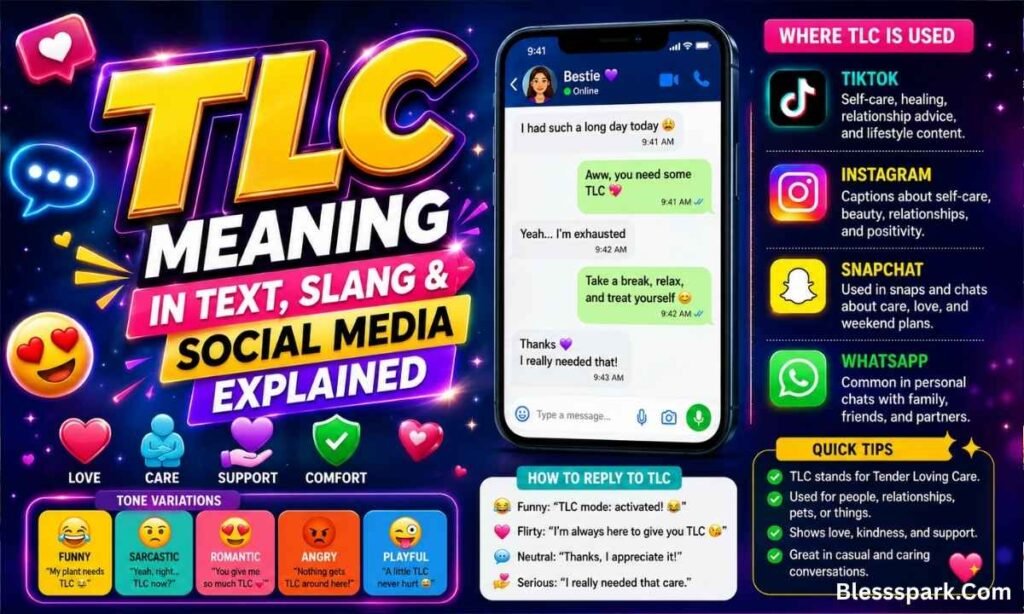
TLC is technically an acronym, not slang, since each letter stands for a specific word — Tender, Loving, Care. But the way people use it in texting and social media has pulled it into slang territory, because the phrase gets applied loosely, sometimes sarcastically, and often without anyone spelling out the full three words in their head.
This is a common point of confusion. An acronym like TLC has a fixed, traceable meaning, while true internet slang — think “no cap” or “rizz” — often doesn’t map directly to specific words at all. TLC sits in between: it started as a clear acronym and got absorbed into everyday texting culture the way slang usually spreads, through repetition and tone rather than formal definition.
Observational Pattern Insight: People rarely stop to think “Tender Loving Care” when typing TLC in a text — the letters have become their own shorthand, functioning more like a mood than a spelt-out phrase.
This matters for how TLC gets used across different tones, because an acronym that’s drifted into slang territory bends more easily depending on who’s saying it and why.
Tone and Context Variations of TLC
The letters TLC don’t change, but the tone behind them can shift the entire meaning of a message. Reading TLC flat, without considering tone, is where most misunderstandings happen.
Funny Tone
Used jokingly, TLC often pokes fun at a minor inconvenience rather than expressing real concern. Someone spills coffee on themselves and texts “this shirt needs some TLC” — nobody thinks they mean actual tender loving care for a shirt. Example: “my room looks like a tornado hit it, it needs some serious TLC.”
Sarcastic Tone
Sarcastic TLC usually shows up after someone complains about a person or situation being difficult. Example: “he clearly needs some TLC because he’s been in a mood all week” — said with an eye-roll energy, not genuine sympathy.
Romantic Tone
Between couples or people who are interested in each other, TLC often signals a wish for closeness or comfort. Example: “Come over, I’ll give you some TLC” carries an affectionate, sometimes flirty undertone, especially late at night or after a rough day for one person.
Angry Tone
Occasionally, TLC gets used with an edge, almost as a passive-aggressive jab — implying someone is being dramatic or overly needy. Example: ” Does someone need a little TLC right now?” said in response to complaining, can come across as dismissive rather than caring.
Playful Tone
Among friends, TLC frequently turns into a light tease. Example: “Aw, does the baby need some TLC?” is a common line used to gently mock someone who’s being a bit whiny, without any real hostility behind it.
Observational Pattern Insight: Tone in these cases almost always comes from what was said right before TLC, not from the letters themselves — the same three letters can comfort or mock depending on the sentence sitting next to them.
Knowing the tone is one thing. Seeing it play out in real conversations makes the pattern much easier to spot.
Real Chat Examples Using TLC
Seeing TLC inside actual message exchanges makes the tone shifts from the last section much easier to recognise in the wild.
Example 1
Friend: “ugh today was so rough.” Reply: “Come over, you need some TLC.” — A simple, sincere offer of comfort between close friends.
Example 2
Crush: “Can’t sleep, mind’s racing.” Reply: “Wish I could give you some TLC right now.” — Romantic and slightly flirty, common late at night.
Example 3
Sibling: “Mom’s on my case again.” Reply: “lol you need some TLC and a nap.” — Casual, affectionate, low-stakes family texting.
Example 4
Coworker: “This project is killing me.” Reply: “Coffee break, you need some TLC before the next meeting.” — Workplace-safe, still friendly without being personal.
Example 5
Group chat: someone posts a screenshot of a failed exam. Reply: “sending TLC 🫶” — a quick, low-effort show of sympathy from multiple people.
Example 6
Partner: “long day, everything went wrong.” Reply: “get home safe, I’ve got TLC waiting for you.” — Warm, intimate, and clearly romantic.
Example 7
Snapchat caption under a tired selfie: “need TLC.” — An open invitation for a comforting reply from whoever sees it.
Example 8
TikTok comment under a self-care video: “giving myself TLC this weekend, no plans, no people.” — Self-directed, not aimed at anyone else.
Example 9
Parent text: “Come for dinner Sunday, you look like you need some TLC.” — Practical and caring, typical of a parent-child dynamic.
Example 10
Sarcastic friend reply: “Oh, does someone need TLC because their favourite team lost?” — Teasing, not comforting.
Example 11
New match on a dating app: “Rough week, could use some TLC.” — Testing the waters for how much comfort the other person is willing to offer this early.
Example 12
Best friend after a breakup: “I’m coming over with snacks, you’re getting full TLC tonight.” — Platonic, warm, and action-oriented.
Example 13
Discord server, gaming friend group: “Lost every match today, someone give me TLC.” — Light, joking, meant to get a laugh rather than real sympathy.
Example 14
Instagram DM after posting about a hard week: “sending TLC, let me know if you need anything.” — Sincere but slightly more distant than a close-friend text.
Example 15
Late-night text from someone you’ve been talking to for a few weeks: “can’t stop thinking about you, wish I could give you some TLC.” — Clearly romantic, and often a sign the relationship is shifting toward something more.
Observational Pattern Insight: Across these fifteen patterns, TLC used late at night or in one-on-one chats skews romantic far more often than TLC used in group settings, which tends to stay platonic and quick.
These examples show the meaning in action — but understanding how TLC actually functions grammatically explains why it slots so easily into so many different message types.
Grammar and Language Role of TLC
Grammatically, TLC functions as a noun phrase standing in for “tender loving care,” and it almost always needs the word “some” or “a little” in front of it to sound natural.
Part of Speech
TLC behaves like an abstract noun — you can’t count it, and it doesn’t take a plural form. People don’t say “two TLCs,” they say “some TLC” or “a lot of TLC,” treating it the same way they’d treat “attention” or “care.”
Sentence Position
Most commonly, TLC sits at the end of a sentence, right after a verb like “needs,” “wants,” or “deserves.” Example: “she needs some TLC” or “give him some TLC.” It rarely opens a sentence on its own, though it can stand alone as a one-word reply to someone describing a hard day.
Does It Replace a Full Sentence?
On its own, TLC can act as a complete reply — someone posts about a bad day, and a single-word comment “TLC” is understood as shorthand for “sending you tender loving care.” This only works because the context (a vent post, a tired selfie, a complaint) already tells the reader what the sender means.
Tone Impact
Where TLC sits in a sentence changes how strong the tone feels. “You need TLC” reads more direct and slightly blunt, while “you could probably use a little TLC right now” softens the same idea and sounds more gentle, almost cautious.
Formal vs Informal Use
TLC rarely appears in formal writing, business emails, or academic contexts, aside from its literal use in fields like nursing or elder care, where “TLC” genuinely refers to hands-on physical care for a patient.
Informal use covers texting, DMs, captions, and casual conversation — the overwhelming majority of how the term appears day to day. Formal use is limited to healthcare, caregiving job descriptions, or product marketing (skincare brands love the phrase “give your skin some TLC”), where it’s used literally rather than as slang.
Understanding the grammar behind TLC makes the next part easier — because knowing how to read it is only half the job. Knowing how to respond is the other half.
How to Reply When Someone Says TLC
There’s no single correct way to respond to TLC — the right reply depends on your relationship with the sender and the tone they used.
Funny Replies
If TLC was clearly a joke, matching that energy works best: “yes please, TLC and snacks only” or “finally, someone gets it.” A funny reply signals you caught the lighthearted tone and aren’t reading too much into it.
Serious Replies
When someone genuinely seems to be struggling, a sincere reply matters more than a clever one: “I’m here, let me know what you need” or “come over, I’ll take care of you tonight.” These replies acknowledge the real emotion behind the message instead of brushing past it.
Flirty Replies
If TLC came from someone you’re interested in, playing along can keep the tone alive: “I’ll give you all the TLC you need” or “wish I was there right now.” This works best when the flirtation was already established earlier in the conversation, rather than assuming interest that isn’t there.
Neutral Replies
For coworkers, acquaintances, or people you’re not particularly close to, a simple, kind reply keeps things appropriate: “hope you feel better soon” or “let me know if you need anything.” Neutral replies avoid over-familiarity while still acknowledging the message.
Observational Pattern Insight: People tend to mirror the tone they were given — a joking TLC gets a joking reply almost every time, while a quiet, late-night TLC usually gets a softer, slower response.
Replying well is easier once you know what TLC actually is compared to similar phrases people often confuse it with.
Comparison Table for TLC Meaning
| Term | Common Meaning | Typical Tone | Best Used With |
| TLC | Tender Loving Care | Warm, caring, sometimes flirty | Friends, partners, family |
| IDK | I Don’t Know | Neutral, uncertain | Anyone, casual context |
| TLDR | Too Long, Didn’t Read | Blunt, dismissive | Long messages, posts |
| XOXO | Hugs and Kisses | Affectionate, closing line | Close friends, partners |
| SMH | Shaking My Head | Disapproving, frustrated | Reacting to something annoying |
This table makes one thing clear: TLC is one of the few common abbreviations that’s genuinely built around comfort rather than reaction or dismissal, which is part of why it holds up across so many different relationships.
Who Uses TLC?
TLC is used across almost every age group that texts, though the tone and frequency shift depending on generation, platform, and region.
Age Group
Teenagers and young adults use TLC most often in group chats and social captions, usually with a lighter, more joking tone. Adults and parents tend to use it more literally, closer to its original meaning of genuine care and rest.
Gen Z vs Millennials
Gen Z tends to use TLC quickly and casually, often in group chats or as a one-word comment under a post, rarely overthinking the phrase. Millennials, having grown up when the phrase was more tied to its literal meaning, tend to use it a bit more sincerely and less as a throwaway reaction.
Region
English-speaking regions — the US, UK, Canada, and Australia — use TLC fairly consistently, though American texting culture tends to use it slightly more often in romantic contexts, while UK usage leans more toward friend groups and family texting.
Platforms Where TLC Is Common
TLC shows up most on Snapchat, Instagram DMs, WhatsApp, and TikTok comment sections. It’s less common on more professional or public-facing platforms like LinkedIn, where the tone doesn’t fit the platform’s formality.
Origin and Internet Culture Insight
The phrase “tender loving care” predates texting entirely, tracing back to everyday spoken English and healthcare contexts long before smartphones existed. What changed is the shorthand — texting culture compressed the full phrase into three letters the same way it did with countless other common expressions.
Possible Origin of TLC
There’s no single documented moment when TLC became common texting shorthand — it likely spread the same way most abbreviations do, through repeated use in casual messaging until it became widely understood without explanation.
TikTok Influence
TikTok’s self-care and “soft life” content trend helped push TLC into a broader, more public use — turning a private, one-on-one phrase into something people also use to caption their own self-care routines for an audience.
Meme Culture Role
TLC occasionally shows up in memes about being “touched starved” or needing comfort, often used humorously to exaggerate how much someone wants attention or affection, blending sincerity with self-aware humour.
Fast Typing Culture
Like most texting abbreviations, TLC persists partly because it’s fast to type and instantly understood — three letters convey a full phrase without slowing down a conversation that’s often moving quickly across multiple messages.
Observational Pattern Insight: Usage skews noticeably younger and more casual on TikTok, while WhatsApp usage skews older and more sincere — the platform itself often predicts the tone before you even read the message.
TikTok’s role in spreading TLC deserves its own closer look, since it’s shaped how an entire generation uses the phrase.
Why People Say TLC on TikTok
On TikTok, TLC has become closely tied to the platform’s broader self-care and “soft life” aesthetic. Videos showing skincare routines, slow mornings, or quiet nights in often use TLC as a caption, framing the whole video around the idea of giving yourself care rather than receiving it from someone else.
This is a noticeable shift from texting culture, where TLC is usually directed at another person. On TikTok, it’s frequently self-directed — “treating myself to some TLC” — turning a comforting phrase into a small personal statement about slowing down and prioritising rest.
Observational Pattern Insight: TikTok captions using TLC spike around weekends and evenings, matching the platform’s broader pattern of self-care content clustering around downtime rather than active, busy hours.
This shift toward self-care use also raises a fair question: does TLC ever come across the wrong way, or is it always read as harmless?
Is TLC Rude or Offensive?
TLC is not considered rude or offensive in any common usage — it’s one of the gentler abbreviations in casual texting. The only time it can land poorly is when it’s used sarcastically toward someone who’s genuinely upset, where the joking tone might feel dismissive rather than funny.
Is TLC Rude?
On its own, no. TLC’s literal meaning is caring and gentle, so even when used jokingly, it rarely crosses into genuinely hurtful territory the way sharper texting slang can.
Is TLC a Bad Word?
Not at all. TLC has no history as an insult or slur, and its acronym roots keep it firmly in comforting, caregiving territory rather than anything negative.
Should You Use TLC at School or Office?
In a school setting among friends, TLC is completely normal and won’t raise eyebrows. In a professional office setting, it’s best kept to casual conversations with close coworkers rather than formal emails or messages to superiors, since it reads as personal rather than businesslike.
Experience-Based Insight
A consistent pattern across platforms is that TLC rarely needs a disclaimer or explanation — unlike slang that can be read multiple conflicting ways, TLC’s meaning stays close to its original definition even when the tone around it changes.
With the tone, grammar, platforms, and appropriateness all covered, the last few common questions tend to be quick ones — the kind people search for right after they’ve already gotten the gist.
Frequently Asked Questions
What Does TLC Mean in Text?
TLC means “Tender Loving Care” and is used to express comfort, concern, or affection toward someone.
Is TLC Rude?
No, TLC is generally seen as warm and caring, not rude, unless used sarcastically toward someone genuinely upset.
What Does TLC Mean on Snapchat?
On Snapchat, TLC usually signals a wish for comfort or affection, often between close friends or someone romantically interested.
Is TLC the Same as IDK?
No, IDK means “I Don’t Know” and expresses uncertainty, while TLC expresses care and comfort — the two aren’t related.
Can Adults Use TLC?
Yes, adults use TLC frequently, often more sincerely and literally than younger users who may use it more casually.
How Do You Respond to TLC?
Match the tone it was sent in — a joking TLC gets a light reply, while a sincere one deserves a warm, genuine response.
What Does TLC Mean on TikTok?
On TikTok, TLC is often used to describe self-care, like a relaxing routine or a slow, restful day.
Is TLC Romantic?
It can be, especially in one-on-one late-night texts or messages between people who are romantically interested in each other.
Does TLC Always Mean Tender Loving Care?
Almost always, though the literal healthcare use of the term also refers to hands-on physical patient care.
Why Do People Say Something Needs TLC?
People say it about objects, homes, or situations to mean they need attention, repair, or care to improve.
Is TLC a Compliment?
Not exactly a compliment, but it’s a kind gesture that shows someone is thinking about your well-being.
Can TLC Be Used for Objects?
Yes, phrases like “this old car needs some TLC” are common and refer to maintenance or repair rather than emotional care.
Is TLC Popular With Gen Z?
Yes, Gen Z uses TLC often, typically in a lighter, quicker, more casual way than older generations do.
Conclusion
TLC has stuck around in texting culture for a simple reason: it says something warm in almost no space at all. Whether it shows up as a quick group chat reaction, a late-night message from someone you’re falling for, or a caption under a self-care TikTok, the core meaning barely moves — someone is acknowledging that a little comfort or attention is needed, even if the delivery is joking, sincere, or somewhere in between.
What changes is everything around it: the platform, the relationship, the time of day, and the words sitting right next to those three letters. Reading TLC well isn’t about memorising a fixed definition — it’s about noticing the small clues that tell you whether someone wants a laugh, a hug, or just to feel heard.
Once you start paying attention to those clues, TLC stops being confusing and starts being one of the easier pieces of texting shorthand to read. The next time it shows up in your messages, you’ll already know exactly how to take it — and exactly how to reply.